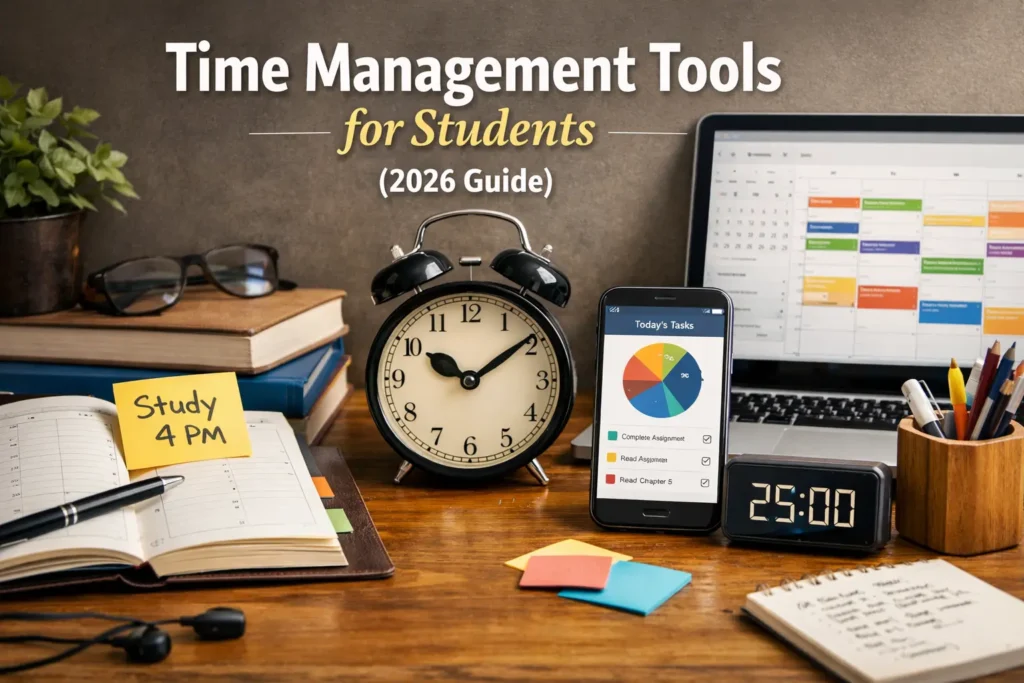

Time Management Tools for Students (2026 Guide)
Time management has always been a challenge for students, but in today’s environment, the difficulty has reached a completely new level. The modern student is not just dealing with academic pressure; they are constantly surrounded by distractions that didn’t exist a decade ago. Smartphones, social media, streaming platforms, and instant messaging all compete for attention every few minutes. Even when a student sits down to study with full intention, it only takes one notification to break focus, and getting back into deep concentration often takes much longer than expected.
Another major issue is the lack of structured routines. Many students today are juggling classes, assignments, part-time work, and personal commitments without a fixed system in place. Instead of following a planned schedule, they rely on memory or last-minute urgency to complete tasks. This creates a cycle of stress where work is either delayed or rushed, leading to inconsistent performance. Over time, this pattern becomes normal, and students start believing they are “bad at managing time,” when in reality, they simply don’t have the right system in place.
What makes things even more complex is the pressure to stay constantly available. Whether it’s group projects, academic group chats, or social expectations, students feel like they need to respond instantly to everything. This fragmented attention makes it extremely difficult to enter a focused study state. As a result, hours are spent being “busy” but not truly productive.
The Hidden Cost of Poor Time Management in Academics
Poor time management does not just affect daily productivity; it slowly impacts a student’s entire academic journey. One of the first visible effects is declining quality of work. Assignments are often completed at the last minute, leaving little time for proper research, editing, or reflection. This directly affects grades, even if the student understands the subject well.
Over time, this habit builds academic stress. Students begin to feel like they are always behind, no matter how much effort they put in. Deadlines start overlapping, revision becomes rushed before exams, and sleep schedules are compromised. This constant pressure creates mental fatigue, which reduces both motivation and learning ability.
There is also a deeper, less visible cost: reduced learning retention. When students study in panic mode, the focus shifts from understanding concepts to simply finishing tasks. Information is memorized temporarily but not absorbed deeply. This means that even after spending long hours studying, the actual retention is low, and the same topics need to be re-learned again and again.
In the long run, this cycle affects confidence. Students start doubting their abilities, not realizing that the real issue is not intelligence but structure. Without proper time management, even highly capable students can underperform consistently, which can affect future opportunities in higher education and careers.
💡You might also like: Data Management Tools
Why Traditional Study Advice No Longer Works
For years, students have been given the same type of advice: make a timetable, avoid distractions, study harder, and stay disciplined. While this advice is not entirely wrong, it is incomplete in today’s context. The problem is that it focuses too much on willpower and not enough on systems.
The reality is that modern distractions are designed to capture attention. Expecting students to rely only on self-control is unrealistic in an environment where every app is competing for engagement. Simply telling someone to “focus more” does not solve the deeper issue of fragmented attention and lack of structure.
Another limitation of traditional advice is that it does not account for complexity. Student life today is not linear. Schedules change frequently, assignments overlap, and priorities shift constantly. A rigid timetable quickly becomes outdated, leading students to abandon it entirely. Once that happens, they often return to unstructured habits again.
What students actually need is not just motivation or discipline, but a flexible system supported by the right tools. Something that helps them organize tasks, manage attention, and adapt to changing demands without losing control. This is where modern time management tools for students become essential. They are not just apps or digital planners; they act as external systems that reduce mental load and create clarity in a chaotic routine.
Once this shift in thinking happens, time management stops being a constant struggle and starts becoming a structured, manageable process.
Task Management Tools That Help Students Organize Academic Work
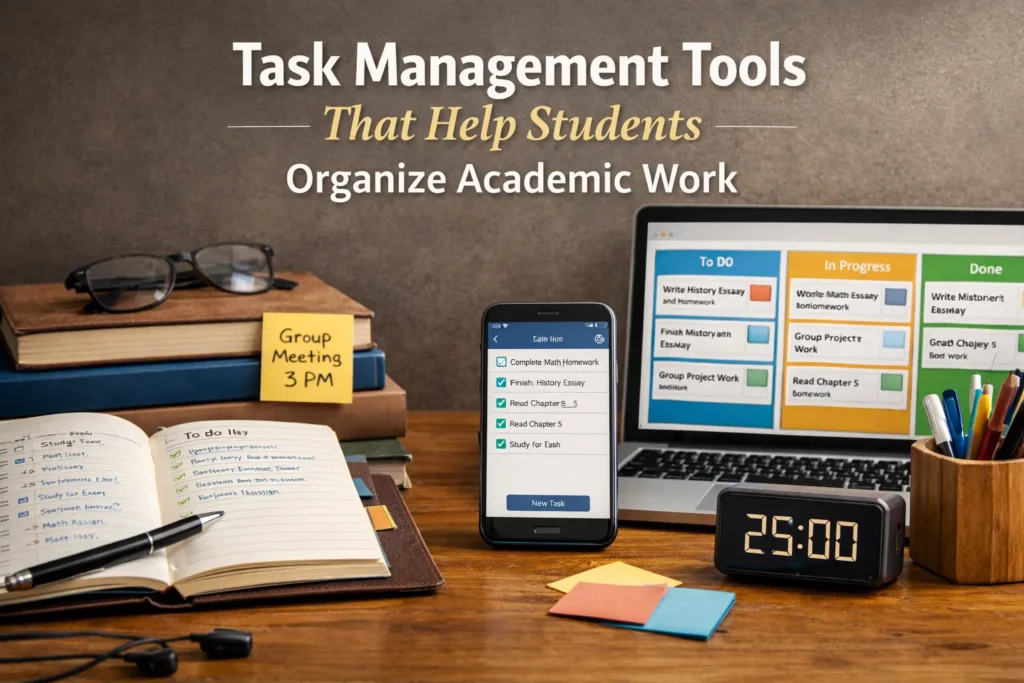
Once students move beyond basic awareness of time management problems, the real challenge becomes organizing academic work in a way that feels manageable instead of overwhelming. This is where task management tools become essential. Instead of keeping everything in memory or scattered notes, these tools allow students to convert academic pressure into a clear, structured system of actions.
At their core, task management tools help students break down large responsibilities into smaller, trackable steps. An assignment that once felt stressful becomes a set of manageable actions like research, outlining, drafting, and editing. This shift is important because most academic stress doesn’t come from difficulty alone, but from the feeling of not knowing where to start.
Modern students benefit most when they stop treating tasks as mental reminders and start treating them as external objects they can organize. When everything is written, categorized, and prioritized in one place, the brain is no longer overloaded trying to remember what needs to be done. Instead, it can focus on actually doing the work.
Another major advantage of task management systems is prioritization. Not all assignments carry the same weight, and not all deadlines are equally urgent. Without a system, students often treat every task as equally important, which leads to confusion and last-minute pressure. With a proper structure, it becomes easier to identify what needs immediate attention and what can be planned for later.
Over time, this approach changes how students think about workload. Instead of reacting to deadlines, they begin to control them. This shift from reactive behavior to planned execution is one of the biggest improvements in academic productivity.
💡You might also like: Data Analytics Tools
Calendar and Scheduling Tools That Build a Structured Study Routine
While task management tools help organize what needs to be done, calendar and scheduling tools focus on when it should be done. This is where real structure begins to form in a student’s routine. Without time allocation, even well-organized tasks can remain unfinished because there is no dedicated space for execution.
A calendar-based system allows students to visually map their entire week or month. Classes, study sessions, assignment deadlines, exams, and even breaks can be placed in a structured timeline. This visual clarity is powerful because it removes uncertainty. Instead of guessing when to study, students already know what their day looks like.
One of the most effective approaches within scheduling is time blocking. Instead of leaving the day open-ended, students assign specific time slots for specific activities. For example, a morning block might be dedicated to focused study, while the evening might be reserved for revision or lighter tasks. This method reduces decision fatigue because students are not constantly deciding what to do next; they simply follow the plan.
Scheduling tools also help create balance. Many students unintentionally overcommit to academics and ignore rest, or vice versa. A structured calendar ensures that study time, rest time, and personal time are all visible and accounted for. This balance is crucial for long-term consistency, especially during exam periods when burnout becomes common.
The key strength of calendar systems is predictability. When students follow a planned schedule consistently, their brains begin to adapt to routine. Over time, studying at a certain hour feels natural instead of forced. This reduces resistance and increases efficiency without additional effort.
Focus and Distraction Control Tools for Deep Study Sessions
Even with proper planning and scheduling, execution remains the hardest part for most students. This is where focus and distraction control tools become critical. The modern digital environment is designed to interrupt attention, and without protective systems, even the best plans can collapse during study sessions.
Focus tools work by creating boundaries around attention. Some tools limit access to distracting apps and websites during study hours, while others use timed study techniques like the Pomodoro method, where work is divided into focused intervals followed by short breaks. This structure helps students maintain concentration without feeling mentally drained.
The importance of these tools becomes clearer when you understand how attention works. The brain is not designed for constant switching between tasks. Every time a student checks their phone or switches tabs, mental energy is lost in refocusing. Over time, this leads to slower progress and lower-quality learning.
By reducing distractions, students enter a deeper state of concentration more easily. This state is often referred to as “deep work,” where complex understanding and problem-solving become significantly more effective. In this state, studying for two hours can often be more productive than six hours of distracted effort.
Focus tools also help build awareness. Many students underestimate how often they get distracted until they actually track it. Once patterns become visible, it becomes easier to change behavior gradually instead of relying on constant self-control.
Note-Taking and Knowledge Organization Tools for Smarter Learning
Time management is not only about managing hours; it is also about reducing the time required to understand and revise information. This is where note-taking and knowledge organization tools play a crucial role in academic efficiency.
Traditional note-taking methods often lead to scattered information across notebooks, files, or apps. When exam time arrives, students spend unnecessary hours searching for content instead of revising it. Organized digital systems solve this problem by centralizing knowledge in one accessible place.
Well-structured notes improve both learning and revision speed. When information is clearly categorized and connected, the brain processes it faster. Instead of relearning material from scratch, students can quickly refresh their understanding and focus on deeper revision.
Another advantage is long-term retention. When notes are structured in a meaningful way using summaries, headings, and linked concepts, it becomes easier to recall information later. This reduces the need for repeated study sessions, saving significant time over the academic year.
In many cases, effective note organization also improves comprehension during the learning phase itself. When students actively structure information instead of passively copying it, they engage more deeply with the subject. This leads to better understanding in less time, which directly supports overall time management goals.
By combining task management, scheduling, focus control, and knowledge organization tools, students begin to build a complete academic system. Each tool supports a different part of the learning process, creating a workflow that reduces stress and increases efficiency at the same time.
How to Combine Multiple Tools Into One Productivity System

By the time students start using time management tools, a common mistake appears: they treat each tool as a separate solution instead of part of a single system. One app is used for tasks, another for notes, and another for scheduling, but nothing is connected. This creates digital clutter instead of clarity.
A real productivity system works when all tools support each other. Tasks should naturally flow into a calendar. Notes should support those tasks. Focus tools should protect the time blocks already created in the schedule. When these elements work together, studying becomes a guided process instead of a daily struggle.
For example, an assignment is first broken into tasks, then placed into a weekly schedule, and finally supported with focused study sessions. Notes taken during those sessions are stored in an organized system that can be revised more quickly later. This chain removes confusion and turns academic work into a predictable workflow.
The key idea here is not to use more tools, but to create a connection between them. Without connection, even the best apps fail to improve productivity. With connection, even simple tools can create a powerful system.
Building a Realistic Study Routine Using Time Blocks
One of the most effective strategies for students is time blocking, but it only works when applied realistically. Many students make the mistake of filling their entire day with back-to-back study blocks, which quickly becomes unsustainable. A proper system respects human energy levels, attention span, and rest needs.
A balanced time-blocking routine divides the day into focused study sessions, revision periods, breaks, and flexible buffer time. The purpose is not to maximize hours but to maximize quality attention during those hours. When study time is clearly defined, procrastination naturally decreases because there is no ambiguity about when work should be done.
Another important aspect of time blocking is adaptability. Student life is unpredictable, and rigid schedules often fail. A strong system allows adjustments without breaking the entire routine. If one block is missed, it is simply moved, not abandoned. This flexibility is what keeps the system sustainable over long academic periods.
Over time, time blocking trains the brain to enter focus mode faster. When study happens at consistent times each day, concentration becomes easier, and resistance decreases. This turns productivity into a habit rather than a constant effort.
Common Mistakes Students Make With Productivity Tools
While time management tools are powerful, many students fail to benefit from them because of how they use them. One of the most common mistakes is overloading themselves with too many apps. Instead of simplifying their system, they end up managing the tools more than their actual studies.
Another frequent issue is constant switching between tools. Students often try a new app every few days, hoping for better results. This prevents consistency, which is the foundation of any effective system. Productivity improves through repetition, not experimentation.
There is also a tendency to rely completely on tools while ignoring personal discipline. Tools can structure work, but they cannot replace action. A perfectly designed system is useless if it is not followed consistently. Students who depend only on apps without building habits often see short-term improvement but long-term failure.
Finally, many students misuse tools by focusing on organization instead of execution. Spending hours arranging tasks or customizing apps feels productive, but it does not move academic work forward. Real productivity comes from doing the work, not perfecting the system.
Turning Time Management Into a Long-Term Academic Skill

Time management should not be treated as a temporary fix for exams or deadlines. It is a long-term skill that shapes how students handle responsibility throughout their academic and professional lives. When developed properly, it becomes a natural way of thinking rather than a forced habit.
The real transformation happens when students stop reacting to deadlines and start planning their time proactively. They begin to understand their energy patterns, work capacity, and focus limits. This awareness allows them to make smarter decisions about how to use their time effectively.
Consistency plays a major role in this process. No tool or system works overnight. It requires repeated use, small adjustments, and gradual improvement. Over time, what once felt difficult becomes automatic.
Students who master time management early gain a significant advantage. They perform better academically, experience less stress, and develop a structured approach to problem-solving. More importantly, they carry this skill into future careers, where time becomes even more valuable.
Conclusion
Time management for students is no longer about simple schedules or motivational advice. It is about building a complete system that combines planning, execution, focus, and learning efficiency. When the right tools are used together in a structured way, students can reduce stress, improve academic performance, and gain control over their daily routines.
The real shift happens when time is no longer something students chase, but something they actively manage. With the right system in place, productivity becomes less about pressure and more about clarity and consistency.
FAQs About Time Management Tools for Students
What are the best free time management tools for students?
The best free tools are those that combine task tracking, scheduling, and focus support. Many students benefit from basic task managers, digital calendars, and Pomodoro-style focus timers that help structure study sessions without complexity.
How can students improve time management without using apps?
Students can improve time management without apps by using paper planners, time blocking in notebooks, and setting fixed daily routines. The key is consistency and structure, not the tool itself.
Is time blocking effective for students with heavy workloads?
Yes, time blocking is especially effective for students with heavy workloads because it ensures every subject and task gets dedicated time. It prevents overload by spreading work evenly across the week.
How many productivity tools should a student use at once?
Ideally, students should use a small, connected system of tools rather than many separate apps. Too many tools create confusion, while a simple system improves consistency and focus.
What is the biggest mistake students make in time management?
The biggest mistake is relying on motivation instead of systems. Students often plan well but fail to follow through because they don’t build a structured, repeatable routine supported by tools.
💡 You don’t need more content, you need better content. Follow Milyom.