
Introduction
Artificial intelligence is reshaping the global workforce faster than almost any previous technology. According to the World Economic Forum’s Future of Jobs Report 2025, AI and information processing technologies are expected to create millions of new jobs while transforming existing roles across industries. Companies are investing heavily in automation, generative AI, machine learning, and data-driven decision-making, creating strong demand for professionals with AI-related skills. Whether you are a student, career changer, or experienced professional, understanding the best AI job opportunities can help you build a future-proof career. This guide explores the highest-demand AI careers, required skills, salary expectations, and long-term growth prospects using the latest industry insights.
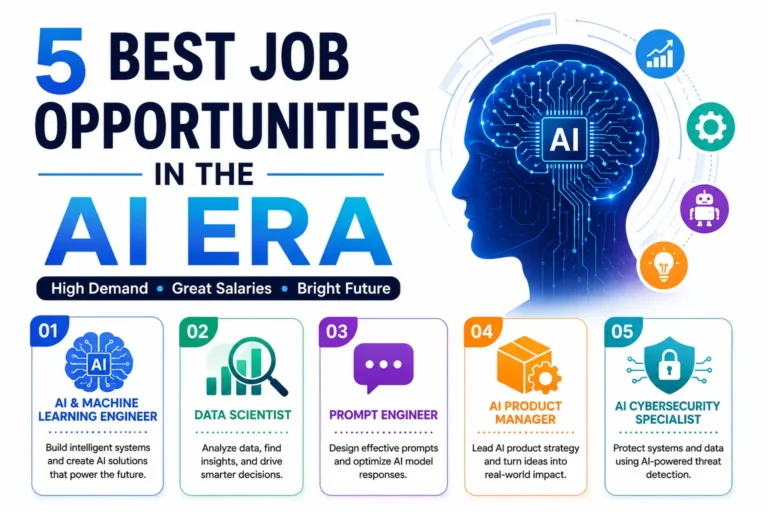
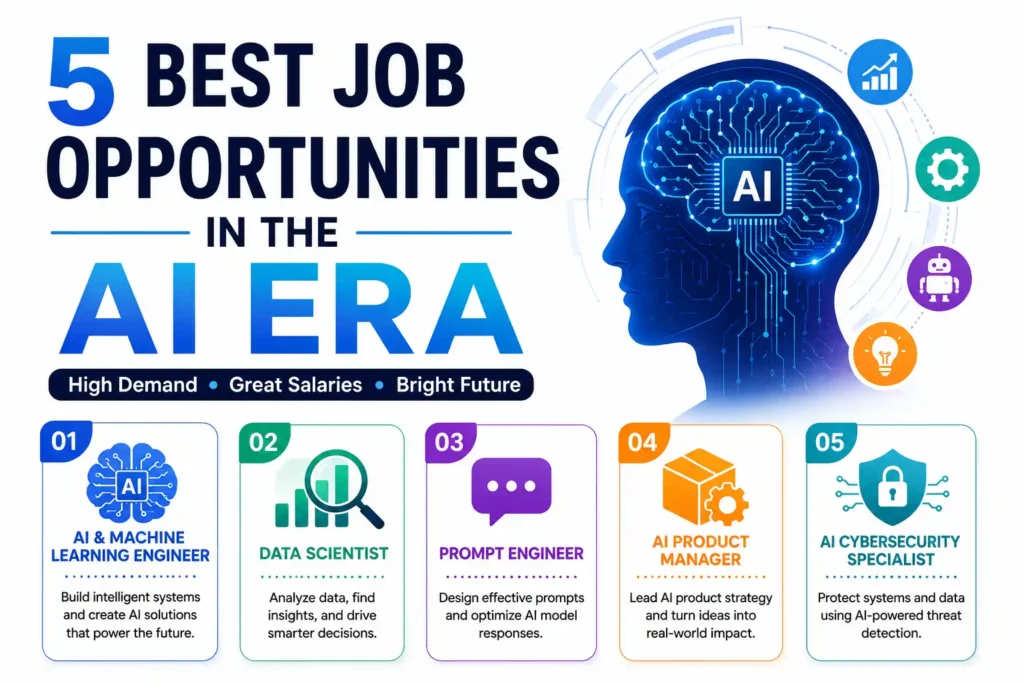
5 Best Job Opportunities in the AI Era
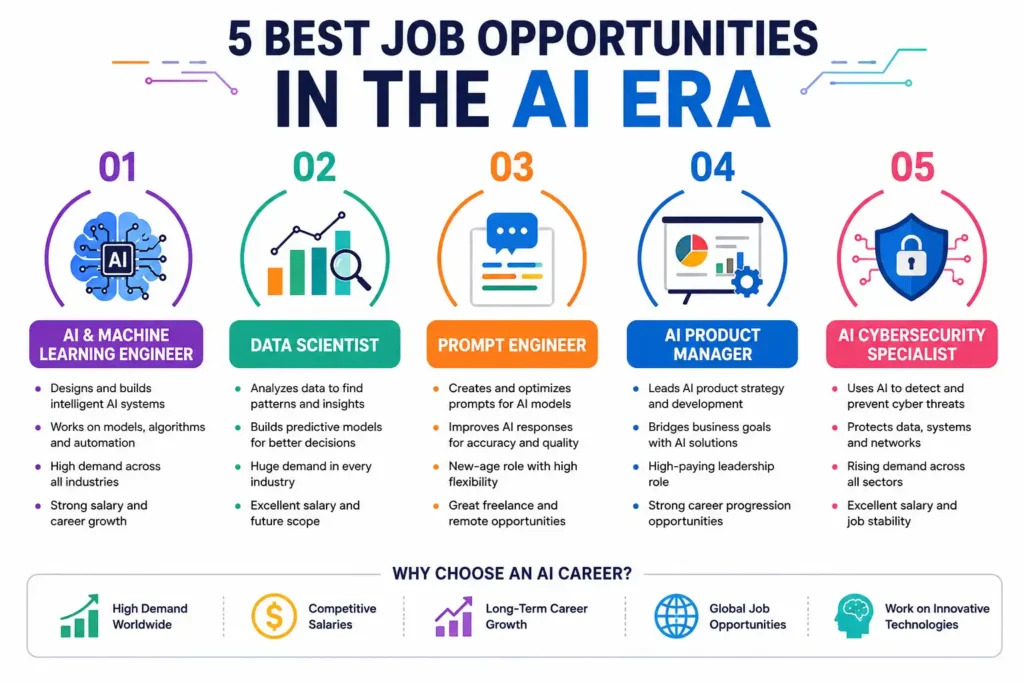
AI Job Opportunity #1: AI & Machine Learning Engineer
AI and Machine Learning Engineers are among the most sought-after professionals in today’s technology market. They design intelligent systems that learn from data, automate business processes, improve customer experiences, and power applications like recommendation engines, autonomous vehicles, healthcare diagnostics, and generative AI tools. The rapid adoption of large language models (LLMs), predictive analytics, and computer vision continues to increase hiring across startups and global enterprises. According to industry reports from LinkedIn, Microsoft, and the World Economic Forum, AI engineering remains one of the fastest-growing career paths, offering excellent salaries, long-term stability, and opportunities across nearly every major industry.
Key Roles and Responsibilities
AI and Machine Learning Engineers build, train, test, and deploy machine learning models. They collect and prepare datasets, optimize algorithms, integrate AI into applications, monitor model performance, and improve accuracy over time. Daily responsibilities often include collaborating with data scientists, software developers, and product teams while ensuring AI systems remain scalable, secure, and aligned with business objectives.
Essential Technical Skills and Tools
Successful AI engineers typically master Python, TensorFlow, PyTorch, Scikit-learn, SQL, cloud platforms such as AWS or Microsoft Azure, and Git. Knowledge of deep learning, natural language processing (NLP), computer vision, and MLOps significantly improves career prospects. Familiarity with generative AI frameworks and APIs is becoming increasingly valuable in modern AI development.
Average Salary and Career Growth
In the United States, experienced AI and Machine Learning Engineers commonly earn six-figure salaries, with compensation varying by experience, location, and specialization. The U.S. Bureau of Labor Statistics projects strong long-term growth for computer and information research occupations, while LinkedIn consistently ranks AI engineering among its fastest-growing jobs due to rising enterprise AI adoption.
Who Should Choose This Career
This career is ideal for individuals who enjoy mathematics, programming, logical problem-solving, and building intelligent software. Professionals with backgrounds in computer science, engineering, data analytics, or software development can transition successfully. Continuous learning is essential because AI technologies, programming frameworks, and machine learning techniques evolve rapidly every year.
🧠 Expand Your Knowledge: How AI Is Changing the Way Startups Build and Scale in 2026
AI Job Opportunity #2: Data Scientist
Data Scientists play a critical role in transforming raw information into actionable business insights. As AI adoption expands, organizations increasingly rely on data professionals to build predictive models, improve decision-making, identify customer behavior, and optimize operations. From healthcare and finance to retail and manufacturing, nearly every industry depends on data science to maximize the value of artificial intelligence. According to LinkedIn’s workforce trends and industry hiring reports, data science continues to rank among the most in-demand technology careers because businesses need accurate, high-quality data to develop reliable AI systems and maintain a competitive advantage.
What Data Scientists Do in AI Projects
Data Scientists collect, clean, analyze, and interpret structured and unstructured data. They build predictive models, evaluate machine learning algorithms, identify trends, and generate insights that support AI applications. Their work helps organizations improve forecasting, automate decision-making, personalize customer experiences, and increase operational efficiency using evidence-based strategies.
Skills, Programming Languages, and Certifications
Employers commonly seek proficiency in Python, R, SQL, statistics, data visualization, machine learning, and cloud analytics platforms. Experience with Tableau, Power BI, TensorFlow, and Jupyter Notebook is highly valued. Certifications from Google, Microsoft, IBM, or AWS can strengthen credibility and demonstrate practical expertise in modern data science techniques.
Industries Hiring Data Scientists
Technology, healthcare, banking, insurance, e-commerce, logistics, manufacturing, education, and government agencies actively recruit Data Scientists. AI-powered decision-making has expanded opportunities beyond traditional technology companies. Organizations increasingly use predictive analytics for fraud detection, personalized marketing, medical research, supply chain optimization, and financial forecasting, creating strong demand across multiple sectors.
Salary Expectations and Career Outlook
Data Scientists enjoy competitive salaries and strong career stability because organizations continue generating massive amounts of business data. Industry research consistently ranks data science among the highest-paying analytical careers. Professionals who combine advanced analytics with AI, cloud computing, and business intelligence often experience faster promotions and expanded leadership opportunities.
🧠 Expand Your Knowledge: 5 Best AI Tools to Automate Business Tasks in 2026
AI Job Opportunity #3: Prompt Engineer
Prompt Engineering has emerged as one of the newest careers created by generative AI. Businesses using AI assistants, large language models, and content generation platforms need professionals who can design effective prompts that improve accuracy, reliability, and business outcomes. Rather than simply asking questions, Prompt Engineers understand how AI models interpret instructions and optimize prompts for better performance. As organizations adopt tools powered by OpenAI, Google Gemini, Anthropic Claude, and Microsoft Copilot, demand continues to grow for specialists who can maximize AI productivity while reducing errors and improving response quality.
What a Prompt Engineer Actually Does
Prompt Engineers create, test, refine, and optimize prompts for AI systems. They evaluate model responses, improve consistency, reduce hallucinations, and develop prompt libraries for business workflows. Their work supports content creation, coding assistance, customer service, research, education, and enterprise automation using modern generative AI platforms.
Core Skills for Writing Effective AI Prompts
Strong Prompt Engineers combine clear communication with analytical thinking. They understand large language models, natural language processing concepts, business workflows, AI limitations, and prompt optimization techniques. Familiarity with ChatGPT, Claude, Gemini, Microsoft Copilot, and Retrieval-Augmented Generation (RAG) provides an additional competitive advantage in today’s AI-driven workplace.
Industries and Companies Hiring Prompt Engineers
Technology companies, digital marketing agencies, healthcare providers, financial institutions, educational platforms, consulting firms, legal organizations, and enterprise software providers increasingly hire Prompt Engineers. Businesses integrating generative AI into customer support, knowledge management, software development, and content production actively seek professionals capable of improving AI performance and reliability.
Career Growth, Freelance, and Remote Opportunities
Prompt Engineering offers flexible career paths, including full-time employment, consulting, and freelance work. Many organizations hire remote AI specialists to optimize workflows across global teams. As generative AI adoption expands, professionals who combine prompt engineering with programming, AI strategy, or automation skills will enjoy stronger long-term career opportunities and higher earning potential.
🧠 Expand Your Knowledge: 5 Best Email Marketing Platforms for Growth (2026)
AI Job Opportunity #4: AI Product Manager
AI Product Managers bridge the gap between business strategy, customer needs, and AI technology. Instead of building AI models themselves, they define product vision, prioritize features, coordinate cross-functional teams, and ensure AI solutions solve real-world problems. As organizations rapidly integrate generative AI into software, healthcare, finance, retail, and enterprise applications, the demand for AI Product Managers continues to grow. According to LinkedIn’s emerging jobs research and industry hiring trends, professionals who combine business expertise with AI knowledge are becoming essential for successful product development, making this one of the most promising leadership careers in the AI era.
Responsibilities of an AI Product Manager
AI Product Managers identify customer needs, define product roadmaps, prioritize AI features, and align business goals with technical capabilities. They oversee product lifecycles, analyse market trends, coordinate launches, monitor key performance indicators (KPIs), and ensure AI solutions deliver measurable value while meeting ethical, privacy, and regulatory requirements.
Business, Technical, and Leadership Skills Required
Successful AI Product Managers combine strategic thinking with technical understanding. Employers value knowledge of machine learning fundamentals, data analytics, Agile methodologies, UX principles, cloud technologies, and AI ethics. Strong communication, stakeholder management, negotiation, and decision-making skills are equally important for leading multidisciplinary teams and driving innovation.
How AI Product Managers Work with Development Teams
AI Product Managers collaborate closely with machine learning engineers, data scientists, software developers, UX designers, marketers, and executives. They translate business objectives into technical requirements, prioritise product features, manage development timelines, and ensure AI products meet customer expectations while balancing performance, scalability, compliance, and commercial success.
Salary, Demand, and Career Progression
AI Product Managers receive highly competitive salaries because they combine technical understanding with business leadership. Demand continues increasing as organisations invest in AI-powered products and digital transformation. Experienced professionals often advance into senior product leadership, Director of Product, Vice President of Product, or Chief Product Officer positions within global technology companies.
🧠 Expand Your Knowledge: Meaimee 3: AI Productivity Tool for Teams & Creators
AI Job Opportunity #5: AI Cybersecurity Specialist
Cybersecurity has become more complex as organisations face increasingly sophisticated cyber threats powered by artificial intelligence. AI Cybersecurity Specialists use machine learning, behavioural analytics, and automated threat detection to identify attacks before they cause damage. Businesses across finance, healthcare, government, manufacturing, and cloud computing rely on AI-driven security systems to protect sensitive information and critical infrastructure.
How AI Is Transforming Cybersecurity
Artificial intelligence enables security teams to analyse enormous volumes of data in real time, detect unusual behaviour, predict emerging threats, and automate repetitive security tasks. AI-powered systems improve malware detection, phishing prevention, fraud identification, vulnerability management, and incident response, allowing organisations to strengthen cyber resilience while reducing manual workloads.
Required Certifications and Technical Skills
Professionals benefit from expertise in cybersecurity frameworks, Python, networking, cloud security, machine learning fundamentals, and threat intelligence. Certifications such as CompTIA Security+, Certified Ethical Hacker (CEH), CISSP, Microsoft Security, and AWS Security validate practical skills and increase employability in competitive cybersecurity positions.
Job Demand Across Industries
Demand for AI Cybersecurity Specialists continues rising across banking, healthcare, government, defence, telecommunications, retail, and technology sectors. Organisations handling sensitive customer information increasingly invest in AI-powered security platforms to protect digital assets, comply with regulations, and defend against rapidly evolving cyberattacks and ransomware campaigns.
Career Growth and Salary Potential
Cybersecurity professionals with AI expertise command premium salaries because specialised talent remains limited. Career paths include Security Engineer, Security Architect, AI Threat Analyst, Security Operations Centre (SOC) Manager, and Chief Information Security Officer (CISO). Continuous learning ensures professionals remain competitive as cyber threats and AI technologies rapidly evolve.
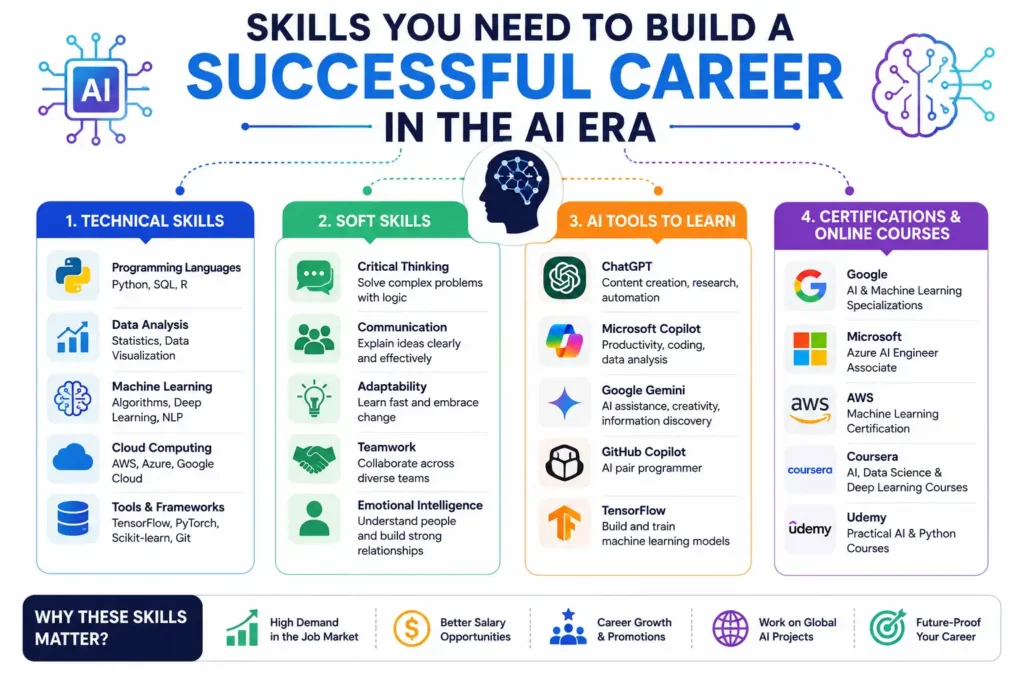
Skills You Need to Build a Successful Career in the AI Era
Technical Skills That Increase Employability
Employers consistently value proficiency in Python, SQL, machine learning, cloud computing, data analysis, APIs, Git, and AI frameworks such as TensorFlow and PyTorch. Knowledge of generative AI, prompt engineering, automation tools, and MLOps further strengthens employability and prepares professionals for rapidly evolving AI-focused roles.
Soft Skills That AI Cannot Replace
Critical thinking, emotional intelligence, creativity, adaptability, ethical decision-making, leadership, and effective communication remain uniquely human strengths. These skills enable professionals to solve complex business challenges, collaborate across teams, build customer relationships, and make strategic decisions that artificial intelligence alone cannot consistently replicate.
Best AI Tools Professionals Should Learn
Learning industry-leading AI platforms improves productivity and career readiness. Valuable tools include ChatGPT, Microsoft Copilot, Google Gemini, Claude, GitHub Copilot, TensorFlow, PyTorch, Hugging Face, Power BI, Tableau, and cloud AI services from AWS, Microsoft Azure, and Google Cloud Platform.
Recommended Certifications and Online Courses
Recognised certifications help validate AI knowledge and practical expertise. Popular options include Google Professional Machine Learning Engineer, Microsoft Azure AI Engineer Associate, AWS Certified Machine Learning Engineer, IBM AI Engineering Professional Certificate, and DeepLearning.AI specialisations. Continuous online learning keeps professionals updated with emerging AI technologies.
Comparison Table of the Top 5 AI Career Opportunities
| AI Career | Primary Focus | Key Skills | Demand | Salary Potential | Best For |
| AI & Machine Learning Engineer | Building AI models and intelligent systems | Python, TensorFlow, PyTorch, Deep Learning, MLOps | Very High | Very High | Software engineers and programmers |
| Data Scientist | Data analysis and predictive modelling | Python, SQL, Statistics, Machine Learning, Data Visualisation | Very High | High | Analytical thinkers and data professionals |
| Prompt Engineer | Optimising AI model responses | Prompt Design, NLP, AI Tools, Communication | High | High | Content creators, AI specialists, consultants |
| AI Product Manager | Managing AI-powered products | Product Strategy, Agile, Leadership, AI Fundamentals | High | Very High | Business leaders with technical understanding |
| AI Cybersecurity Specialist | AI-powered threat detection and digital security | Cybersecurity, Networking, Python, Cloud Security, AI Analytics | Very High | Very High | Security professionals and IT specialists |
How to Start Your AI Career in 2026 and Beyond
Breaking into AI has never been more achievable, thanks to the growing availability of online learning platforms, open-source tools, and industry-recognized certifications. While some advanced AI roles require strong programming skills, many entry points now exist for professionals with backgrounds in business, marketing, design, finance, or cybersecurity. Employers increasingly value practical experience over degrees, making portfolios and real-world projects essential. By following a structured learning path, gaining hands-on experience, and staying updated with emerging AI technologies, you can build a competitive profile and prepare for one of the fastest-growing career markets in the world.
Step-by-Step Learning Roadmap
Start by learning Python, basic mathematics, statistics, and SQL. Next, study machine learning, generative AI, and cloud computing through reputable platforms. Build small AI projects, earn industry certifications, contribute to GitHub, and practise solving real-world business problems. Finally, apply for internships, freelance opportunities, or entry-level AI positions to gain practical experience.
Building an AI Portfolio That Gets Interviews
A strong portfolio demonstrates practical skills better than a résumé alone. Include machine learning projects, data analysis dashboards, prompt engineering examples, automation workflows, and GitHub repositories. Clearly explain your problem-solving approach, tools used, measurable results, and business impact. Employers value evidence of hands-on experience and continuous learning.
Common Mistakes to Avoid When Entering AI Careers
Many beginners focus only on theory without building practical projects. Others ignore mathematics, communication skills, or cloud technologies. Avoid relying solely on AI tools without understanding core concepts. Stay updated with industry trends, build a professional network, and continuously improve your portfolio to remain competitive in the evolving AI job market.
Frequently Asked Questions (FAQs)
What are the best job opportunities in the AI era?
Some of the most promising AI careers include AI & Machine Learning Engineer, Data Scientist, Prompt Engineer, AI Product Manager, and AI Cybersecurity Specialist. These roles offer excellent job growth, competitive salaries, and opportunities across industries such as healthcare, finance, manufacturing, education, and technology as AI adoption continues to accelerate worldwide.
Which AI job has the highest salary?
AI & Machine Learning Engineers and AI Product Managers are generally among the highest-paid AI professionals, particularly at large technology companies. Compensation depends on experience, specialization, location, and industry. Professionals with expertise in generative AI, cloud computing, and large language models often command the highest salaries in today’s market.
Do I need a computer science degree to work in AI?
No. While a computer science degree can be beneficial, many employers now prioritize practical skills, certifications, and project experience over formal education. Self-taught professionals, bootcamp graduates, and career changers successfully enter AI by building strong portfolios, earning recognized certifications, and demonstrating real-world problem-solving abilities.
Which AI career is best for beginners?
Prompt Engineering, Data Analysis, and junior Data Science roles are excellent starting points for beginners. These careers provide practical exposure to AI technologies without requiring deep expertise in advanced machine learning. As your knowledge grows, you can transition into more specialized positions such as Machine Learning Engineering or AI Product Management.
What skills are required to get an AI job?
Most AI employers look for Python, SQL, machine learning fundamentals, data analysis, cloud computing, and familiarity with AI frameworks like TensorFlow or PyTorch. Equally important are communication, critical thinking, teamwork, adaptability, and business problem-solving skills, which help professionals collaborate effectively and deliver successful AI solutions.
Is prompt engineering still a decent career choice in 2026?
Yes. Prompt engineering remains valuable because organizations continue adopting generative AI tools for customer support, software development, research, marketing, and business automation. However, employers increasingly prefer professionals who combine prompt engineering with domain expertise, automation skills, data analysis, or programming knowledge, making broader AI capabilities a significant competitive advantage.
Conclusion
Whether you choose to become an AI & Machine Learning Engineer, Data Scientist, Prompt Engineer, AI Product Manager, or AI Cybersecurity Specialist, each path offers strong demand, excellent earning potential, and long-term career growth.
The key to success is developing both technical and human skills while continuously adapting to new technologies. Start with a clear learning roadmap, build real-world projects, earn trusted certifications, and stay curious. As AI continues transforming every industry, professionals who embrace lifelong learning and practical experience will be best positioned to thrive in the AI-powered workplace of 2026 and beyond.
✨ Liked this breakdown? Stick around, follow Milyom.