
What Is the B58 Engine?
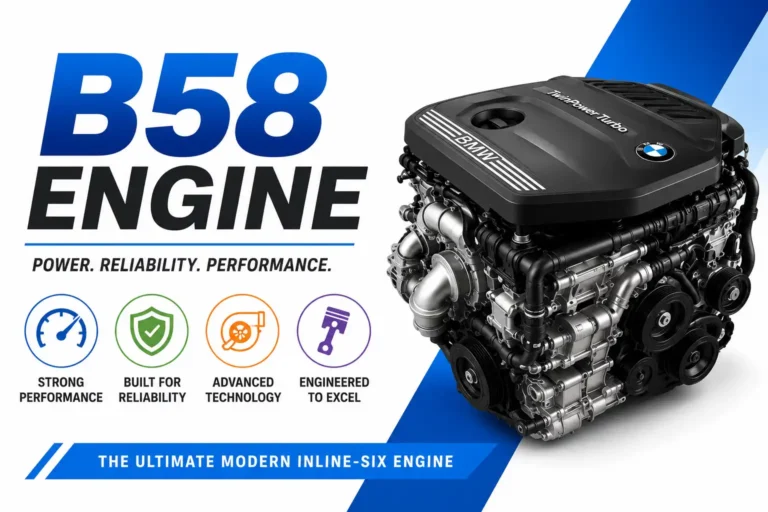
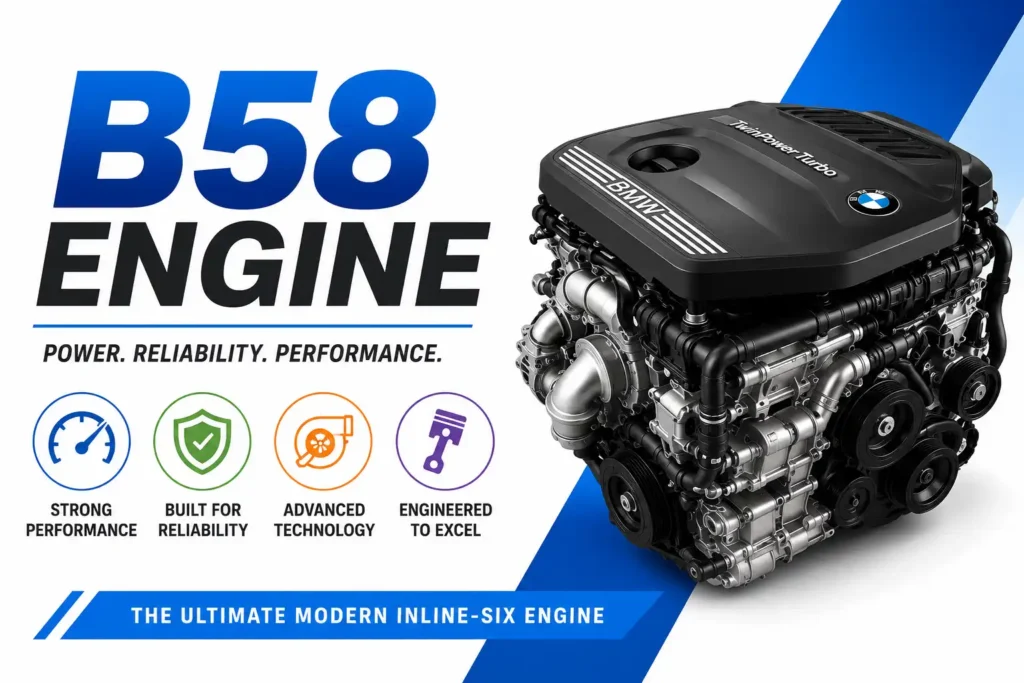
The BMW B58 engine is a 3.0-liter turbocharged inline-six gasoline engine introduced in 2015 as part of BMW’s modular B-Series engine family. Designed to replace the popular N55, it delivers greater power, stronger reliability, improved fuel efficiency, and lower emissions. The B58 features advanced engineering, including a closed-deck aluminum block, direct fuel injection, Double VANOS variable cam timing, and Valvetronic valve control. It has earned widespread praise from automotive experts for its smooth power delivery and impressive tuning potential. Today, the B58 powers numerous BMW performance models and the Toyota GR Supra, making it one of the most respected modern six-cylinder engines.
B58 Engine Specifications at a Glance
The B58 engine combines modern engineering with outstanding performance, making it one of BMW’s most versatile powerplants. It features a 2,998 cc (3.0-liter) inline-six configuration with a single twin-scroll turbocharger and direct fuel injection. Depending on the model and generation, factory output ranges from approximately 322 horsepower to over 382 horsepower, while torque reaches up to 369 lb-ft (500 Nm) in many variants. The engine uses an aluminum closed-deck block, forged crankshaft, integrated water-to-air intercooler, and an 11.0:1 compression ratio. These technologies help deliver strong acceleration, improved thermal efficiency, lower emissions, and dependable performance for both daily driving and enthusiast applications.
Key Features That Make the B58 Engine Stand Out
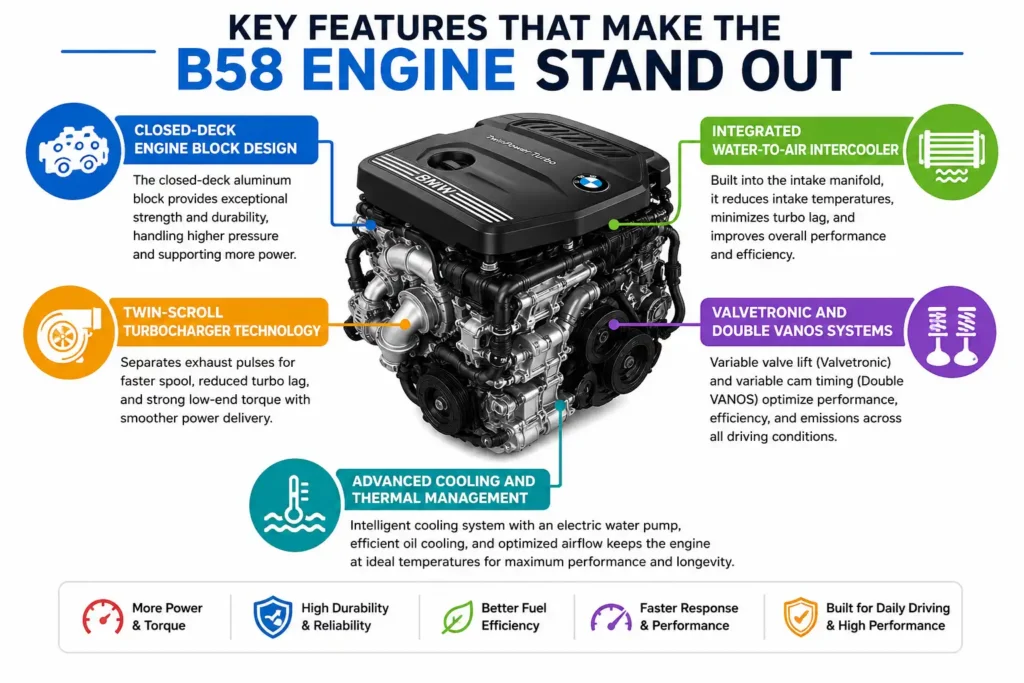
BMW engineered the B58 with several advanced technologies that improve durability, efficiency, and overall driving performance. Compared with its predecessor, the engine offers stronger internal components, enhanced cooling, and a more compact design. These improvements allow the B58 to produce higher power while maintaining excellent reliability under demanding conditions. Features such as the closed-deck engine block, integrated intercooler, twin-scroll turbocharger, Valvetronic system, Double VANOS, and intelligent thermal management work together to deliver faster throttle response, consistent power output, reduced turbo lag, and impressive long-term dependability.
Closed-Deck Engine Block Design
The B58 uses a closed-deck aluminum engine block, providing significantly greater structural strength than the open-deck design used in older BMW engines. This design better supports cylinder walls under high combustion pressure, improving durability during spirited driving and performance tuning. The stronger block also helps the engine safely handle substantial horsepower increases while maintaining excellent long-term reliability and engine stability.
Integrated Water-to-Air Intercooler
Unlike conventional front-mounted intercoolers, the B58 features an integrated water-to-air intercooler built directly into the intake manifold. This design shortens the airflow path, reducing turbo lag while lowering intake air temperatures. Cooler, denser air improves combustion efficiency, increases horsepower consistency, and helps maintain peak performance even during repeated acceleration or demanding driving conditions.
Twin-Scroll Turbocharger Technology
BMW equipped the B58 with a single twin-scroll turbocharger that separates exhaust pulses from different cylinders before they reach the turbine. This design minimizes exhaust interference, allowing the turbo to spool more quickly and efficiently. Drivers benefit from stronger low-end torque, faster throttle response, smoother acceleration, and improved fuel economy compared with traditional single-scroll turbocharger systems.
Valvetronic and Double VANOS Systems
The B58 combines Valvetronic variable valve lift with Double VANOS variable camshaft timing to optimize airflow throughout the engine’s operating range. These systems continuously adjust valve timing and lift based on driving conditions, improving power output, fuel efficiency, idle quality, and emissions. Together, they deliver responsive performance while helping the engine meet modern environmental standards.
Advanced Cooling and Thermal Management
BMW designed the B58 with an advanced thermal management system that carefully controls engine operating temperatures. An electronically controlled coolant pump, optimized oil cooling, and efficient coolant routing help the engine warm up quickly while preventing overheating during high-performance driving. This intelligent cooling strategy improves engine longevity, reduces wear, and supports consistent power delivery under varying conditions.
BMW Models Equipped with the B58 Engine
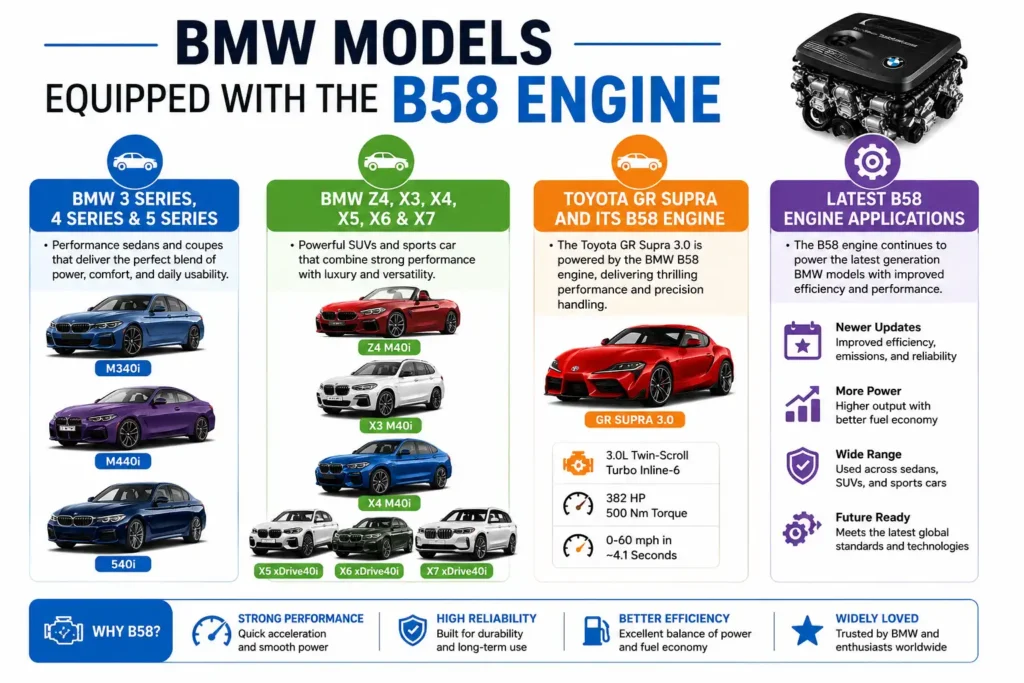
Since its debut, the B58 has powered a wide range of BMW cars and SUVs across multiple vehicle segments. BMW has continuously refined the engine through technical updates, improving efficiency, emissions compliance, and overall performance. The engine is found in luxury sedans, sporty coupes, high-performance SUVs, and even the Toyota GR Supra through BMW’s engineering partnership with Toyota. Its flexibility, reliability, and excellent performance have made it one of BMW’s most widely used modern gasoline engines.
BMW 3 Series, 4 Series, and 5 Series
The B58 powers several popular BMW sedans and coupes, including the M340i, 440i, M440i, 540i, and selected regional variants. These vehicles combine everyday comfort with strong performance, often producing between 335 and 382 horsepower depending on the model year.
BMW Z4, X3, X4, X5, X6, and X7
BMW also installs the B58 in several SUVs and sports cars, including the Z4 M40i, X3 M40i, X4 M40i, X5 xDrive40i, X6 xDrive40i, and X7 xDrive40i. Even in larger vehicles, the turbocharged inline-six delivers confident acceleration, refined cruising performance, and respectable fuel efficiency while maintaining the smooth driving experience BMW is known for.
Toyota GR Supra and Its B58 Engine
The fifth-generation Toyota GR Supra shares BMW’s B58 engine under a joint engineering partnership between Toyota and BMW. While Toyota fine-tuned suspension, steering, and overall driving dynamics, the turbocharged 3.0-liter inline-six remains fundamentally a BMW-designed powerplant. Its exceptional tuning capability, smooth performance, and strong factory reliability have made the Supra a favorite among sports car enthusiasts worldwide.
Latest B58 Engine Applications
BMW continues expanding the B58 across its latest lineup with ongoing engineering improvements. Newer versions feature updated engine management software, enhanced emissions systems, improved combustion efficiency, and mild-hybrid technology in selected markets. The latest B58 variants power vehicles such as the 2025 M340i, 540i, X5 xDrive40i, 740i, and other premium BMW models, ensuring the engine remains competitive in today’s performance-focused automotive market.
Here’s the next section of your article following the same style, SEO structure, AEO optimization, conversational US English tone, and approximately 95 words for each H2 and 60 words for each H3.
📌 Don’t Miss These Articles: Top Safety Features to Consider When Booking a Charter Bus Rental in Nebraska
B58 Engine Performance, Driving Experience, and Fuel Economy
The BMW B58 engine is widely praised for delivering an ideal mix of performance, refinement, and efficiency. Its turbocharged inline-six design produces strong low-end torque, smooth power delivery, and quick acceleration without sacrificing everyday comfort. Thanks to modern technologies like direct fuel injection, a twin-scroll turbocharger, and intelligent thermal management, the engine remains responsive across the entire RPM range. Whether you’re commuting, taking a weekend road trip, or enjoying spirited driving on winding roads, the B58 provides a balanced driving experience while maintaining competitive fuel economy for a high-performance six-cylinder engine.
Acceleration and Power Delivery
One of the B58’s biggest strengths is its instant power delivery. The twin-scroll turbocharger builds boost quickly, producing strong torque from around 1,500 RPM. The engine delivers smooth, linear acceleration with minimal turbo lag, making it equally enjoyable in city traffic and highway driving.
Real-World Fuel Efficiency
Despite its impressive performance, the B58 offers respectable fuel economy. Most BMW models equipped with this engine achieve approximately 22–25 mpg in city driving and 29–32 mpg on the highway, depending on vehicle weight, drivetrain, and driving habits. Efficient combustion, precise fuel injection, and advanced engine management help drivers enjoy strong performance without excessive fuel consumption during normal daily use.
Daily Driving vs Track Performance
The B58 is equally capable on public roads and race tracks. During daily driving, it delivers smooth operation, quiet cruising, and excellent throttle response. Under aggressive driving conditions, the engine maintains consistent power thanks to its advanced cooling system and durable internal components. This versatility makes the B58 one of the few turbocharged engines that comfortably serves both commuters and driving enthusiasts.
Is the B58 Engine Good for Long-Term Use?
Yes. The B58 has developed an excellent reputation for long-term ownership. Its closed-deck engine block, forged crankshaft, improved cooling system, and refined engineering contribute to exceptional durability. Owners who follow BMW’s recommended maintenance schedule often report dependable performance well beyond 150,000 to 200,000 miles, making it one of the brand’s most reliable modern turbocharged gasoline engines.
B58 Engine Reliability and Common Problems
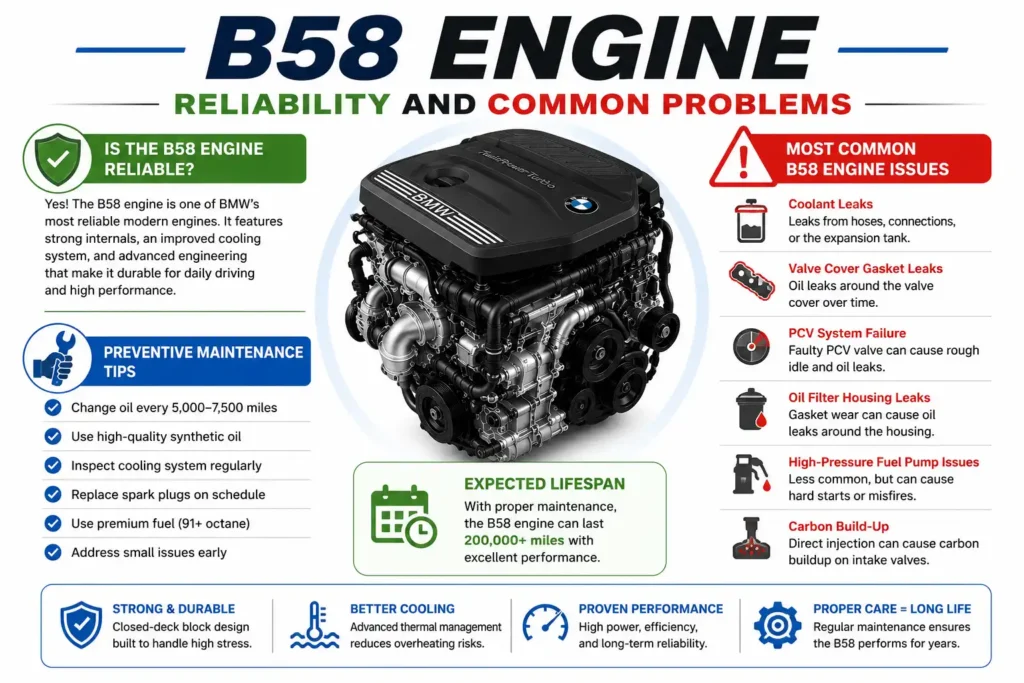
Among BMW enthusiasts and independent mechanics, the B58 is considered one of the company’s most reliable turbocharged engines. BMW addressed many weaknesses found in previous engines by strengthening internal components, improving cooling efficiency, and refining overall engine management. While no engine is completely maintenance-free, the B58 has demonstrated impressive durability in both stock and lightly modified applications. Understanding its common issues and following preventive maintenance practices can significantly reduce repair costs while extending engine life and maintaining consistent long-term performance.
Is the B58 Engine Reliable?
Yes. The B58 consistently ranks among BMW’s most dependable modern engines. Automotive reviewers and long-term ownership reports frequently highlight its strong reliability, especially when compared with the older N54 and N55 engines. Improved engineering, stronger internals, and better thermal management have significantly reduced the frequency of major engine failures, earning widespread praise from enthusiasts and professional technicians alike.
Most Common B58 Engine Issues
Although generally reliable, some owners have reported issues including coolant leaks, valve cover gasket wear, PCV system failures, oil filter housing leaks, and occasional high-pressure fuel pump problems. Carbon buildup on intake valves may also occur over higher mileage because the engine uses direct fuel injection. Fortunately, these issues are typically manageable with timely diagnosis and proper maintenance.
Preventive Maintenance Tips
Routine maintenance is the best way to maximize B58 reliability. Use high-quality synthetic oil, replace oil every 5,000–7,500 miles instead of extending intervals, inspect coolant hoses regularly, change spark plugs on schedule, and use premium fuel with the recommended octane rating. Regular inspections help detect small issues before they become expensive repairs, especially on tuned vehicles.
Expected Lifespan of the B58 Engine
With proper maintenance, many automotive specialists estimate the B58 can comfortably exceed 200,000 miles (320,000 km) without requiring a major engine rebuild. Longevity depends on driving habits, maintenance quality, and modification levels. Stock engines that receive consistent servicing generally experience fewer mechanical problems than heavily modified examples operated under extreme performance conditions.
📌 Don’t Miss These Articles: Business Development Manager: Roles, Skills, Salary & Career Guide (2026)
B58 Engine Tuning and Performance Upgrades
The B58 has become one of the most popular turbocharged engines in the aftermarket because of its impressive tuning capability. Its robust closed-deck block, efficient turbocharger, and strong internal components allow significant horsepower gains with relatively simple upgrades. From ECU tuning to upgraded fuel systems and larger turbochargers, enthusiasts can build anything from a responsive daily driver to a high-horsepower track machine. Choosing quality components and professional tuning is essential for maximizing performance while maintaining long-term reliability.
Stage 1, Stage 2, and Stage 3 Tuning Explained
A Stage 1 tune typically requires only ECU software and can add 50–80 horsepower. Stage 2 usually includes a high-flow downpipe, intake, and upgraded intercooling for greater performance. Stage 3 combines larger turbochargers, upgraded fueling components, and custom tuning, allowing experienced builders to achieve significantly higher horsepower while supporting aggressive driving applications.
Best Supporting Modifications
Popular supporting upgrades include a high-flow intake system, performance downpipe, upgraded charge pipe, larger heat exchanger, colder spark plugs, stronger ignition coils, and improved intercooler components. These modifications improve airflow, lower intake temperatures, and enhance engine reliability under increased boost pressure, creating a balanced setup that supports both performance and durability.
Safe Power Limits on the Stock Engine
Many experienced BMW tuners consider 500–600 wheel horsepower (whp) a generally achievable range for healthy stock-internal B58 engines when properly tuned and maintained. Results vary based on fuel quality, turbocharger efficiency, and engine condition. Conservative tuning and professional calibration remain critical for preserving long-term reliability while extracting additional performance.
Upgraded Turbocharger and Fuel System Options
For higher horsepower goals, enthusiasts often install hybrid or larger aftermarket turbochargers paired with upgraded high-pressure fuel pumps, port injection systems, larger injectors, and ethanol-compatible fuel setups. These supporting upgrades allow the engine to safely deliver substantially more power while maintaining proper air-fuel ratios and combustion stability under heavy load.
📌 Don’t Miss These Articles: What Businesses Can Learn from Engineering Quality Standards
B58 Engine Maintenance Costs and Ownership Guide
Owning a BMW B58 engine is generally less expensive than many older BMW turbocharged six-cylinder engines, but it still requires consistent maintenance to remain reliable. The engine benefits from improved engineering, stronger internal components, and better thermal management, which help reduce unexpected failures. However, regular servicing is essential because turbocharged direct-injection engines operate under higher temperatures and pressures than naturally aspirated engines. Understanding the recommended service schedule, routine fluid changes, typical repair costs, and proven ownership practices will help you budget accurately and keep a B58-powered BMW performing smoothly for many years.
Recommended Service Schedule
BMW’s factory service intervals can be relatively long, but many independent BMW specialists recommend more frequent maintenance for the B58. Engine oil should ideally be changed every 5,000–7,500 miles, while air filters should be inspected annually and replaced as needed. Spark plugs are commonly replaced every 30,000–40,000 miles, coolant should be refreshed approximately every 4 years, and transmission servicing is often recommended around 60,000 miles for long-term reliability.
Oil, Spark Plugs, and Coolant Maintenance
Using the correct fluids is critical for the B58. BMW recommends a high-quality synthetic oil meeting BMW Longlife specifications, typically in a 0W-20 or 5W-30 viscosity depending on climate and model year. Fresh spark plugs help maintain efficient combustion and prevent misfires under boost. Coolant maintenance is equally important because the B58’s integrated intercooling and advanced thermal management system depend on stable operating temperatures.
Average Repair and Ownership Costs
Routine ownership costs for a B58-powered BMW are generally moderate for a premium performance vehicle. An oil service typically ranges from $100–$180, spark plug replacement from $200–$400, and coolant service from $150–$300. Common repairs such as valve cover gasket replacement or coolant hose repairs may cost $400–$900 depending on labour rates. Overall annual maintenance expenses are often lower than those associated with older BMW N54 models.
Tips to Maximize Engine Life
The best way to extend B58 engine life is to combine frequent oil changes, premium fuel, and regular inspections. Allow the engine to reach operating temperature before aggressive driving, avoid repeated short trips when possible, and inspect coolant hoses and gaskets during routine servicing. Conservative tuning, proper warm-up and cool-down habits, and addressing small leaks early can significantly improve long-term durability and reduce ownership costs.
Frequently Asked Questions (FAQs)
What is the B58 engine?
The B58 is BMW’s 3.0-litre turbocharged inline-six petrol engine introduced in 2015. It belongs to BMW’s modular B-Series engine family and replaced the older N55 engine. Key technologies include a closed-deck aluminium block, twin-scroll turbocharger, direct fuel injection, Double VANOS, and Valvetronic, all of which contribute to its strong performance, efficiency, and reliability.
Which BMW models come with the B58 engine?
The B58 is used in a wide range of BMW vehicles, including the M340i, 540i, M440i, Z4 M40i, X3 M40i, X5 xDrive40i, X7 xDrive40i, and several other current BMW models. It is also used in the Toyota GR Supra 3.0, which shares BMW’s turbocharged inline-six powertrain through a joint development partnership.
Is the B58 engine reliable for daily driving?
Yes. Its stronger closed-deck block, improved cooling system, and refined internal components make it well suited for everyday commuting, highway driving, and long-distance travel. Owners who follow proper maintenance schedules generally report excellent dependability and lower failure rates than older BMW turbocharged six-cylinder engines.
How long does a B58 engine last?
With proper maintenance, a B58 engine can often last 150,000–200,000 miles or more before requiring major internal repairs. Regular oil changes, quality fuel, timely spark plug replacement, and proper cooling system maintenance play the biggest role in achieving high mileage. Many BMW specialists consider the B58 capable of exceeding 200,000 miles when maintained correctly and kept close to stock specifications.
What are the most common B58 engine problems?
Although generally reliable, the B58 can experience coolant leaks, valve cover gasket wear, PCV system issues, oil filter housing leaks, and occasional high-pressure fuel pump problems. Carbon buildup on intake valves may also occur over higher mileage because the engine uses direct fuel injection. Most of these issues are manageable and rarely result in catastrophic engine failure when addressed early.
Is the B58 engine better than the N55?
For most drivers, yes. The B58 offers more power, better fuel efficiency, stronger internal construction, improved cooling, and significantly better tuning potential than the N55. It also has a stronger reliability reputation, particularly for higher-mileage ownership and modified applications. While the N55 remains a capable engine, the B58 is generally considered the superior all-around choice for performance, durability, and long-term ownership.
📌 Don’t Miss These Articles: 5 Best Workforce Tools for Businesses in 2026
Conclusion
The BMW B58 engine has earned its reputation as one of the finest modern turbocharged inline-six engines available. It combines strong factory performance, smooth power delivery, impressive fuel efficiency, excellent tuning potential, and outstanding long-term reliability in a way few competitors can match. Whether installed in a BMW sports sedan, luxury SUV, or the Toyota GR Supra, the B58 consistently delivers an engaging driving experience without the major reliability concerns associated with some earlier BMW turbo engines. For enthusiasts seeking a powerful yet dependable six-cylinder engine, the B58 remains one of the smartest choices in today’s performance car market.
✨ Want smarter takes like this? Tap follow on Milyom.