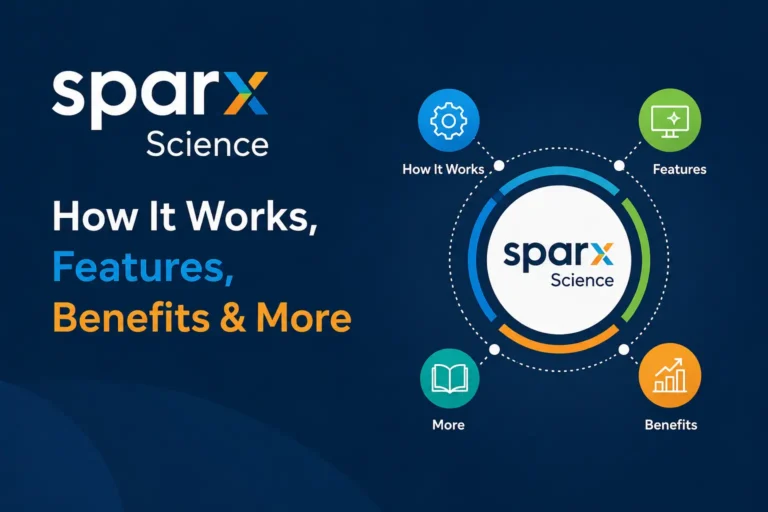


Sparx Science: How It Works, Features, Benefits & More
Digital learning platforms are changing the way students study outside the classroom. Instead of relying only on textbooks and worksheets, students can now use online tools that provide practice, feedback, and personalised support. Sparx Science is one such platform, designed to help secondary-school students build their science knowledge through personalised homework and regular practice.
Sparx Science is part of the wider Sparx Learning ecosystem and is aimed at students aged 11 to 16. The platform currently supports KS3 science as well as GCSE courses, including AQA and Edexcel specifications. Its technology-focused approach makes it a useful example of how educational software can bring adaptive learning into everyday schoolwork.
This guide looks at what Sparx Science is, how it works, what features it provides, and how its technology can support students and teachers.
What Is Sparx Science?
Sparx Science is an online science-learning and homework platform built around personalised practice. Rather than giving every student exactly the same set of questions, the platform uses technology to adjust learning and provide support based on the student’s work.
Its main goal is not simply to help students complete questions. Sparx says its system is designed to build scientific knowledge and understanding while helping students become more confident and independent learners. Its question bank contains more than 23,000 questions covering areas such as biology, chemistry, physics, working scientifically, and maths for science.
The platform is primarily designed for school use. Teachers can connect their science curriculum and schemes of learning with Sparx Science, allowing homework to reflect what students are studying in class. This gives the platform a more structured role than a general science website where students simply browse educational content.
That connection between classroom teaching and digital practice is one of the reasons Sparx Science fits naturally into the EdTech space. It combines curriculum-based learning with software, automated marking, adaptive support, and performance insights.
How Does Sparx Science Work?
The process starts with the school’s science department setting up its scheme of learning within the platform. Sparx Science can then generate homework based on the topics teachers have selected. This reduces the amount of manual work required to create and mark regular assignments.
A typical homework task is designed around several types of practice. According to Sparx, its current homework structure includes questions from topics taught that week, consolidation of previously assigned material, and flashcard practice. The platform also revisits older topics, so students have opportunities to reinforce knowledge rather than learning something once and immediately moving on.
This approach is particularly relevant to science because many concepts build on earlier knowledge. A student who has forgotten a basic concept may struggle when a later topic depends on it. Regular retrieval and revision can therefore help maintain those foundations.
Another important part of the system is adaptive support. When students find a question difficult, Sparx Science provides guided help intended to move them toward the answer instead of simply revealing it. The company says this support is designed to address misconceptions and gaps in understanding.
➡️ Explore Related Content:: How Classroom 30x Helps Students Learn Faster in 2026
What Subjects Does Sparx Science Cover?
Sparx Science focuses on the main areas students encounter during secondary science education. Its current platform covers biology, chemistry, physics, working scientifically, and maths for science. It supports KS3 content aligned with the national curriculum and GCSE content aligned with AQA and Edexcel specifications.
This curriculum alignment is important because online learning is most useful when it connects with what a student is already expected to learn at school. Instead of treating science as a collection of unrelated facts, the platform can organise practice around the curriculum students are actually following.
At GCSE level, Sparx Science also includes topics connected with required practical work and working scientifically skills. This allows students to practise not only subject knowledge but also some of the skills needed to approach scientific questions and practical investigations.
How Technology Personalises Science Practice
The technology behind Sparx Science is one of its most notable features. Its purpose is to make digital practice more responsive to individual students rather than treating the entire class as if everyone has identical strengths and weaknesses.
The platform can use previous performance to determine areas that need additional practice. Its Independent Learning feature, for example, allows students to practise topics from the wider content library without waiting for a teacher to assign homework. Personal practice can include questions based on areas students have struggled with previously or topics that need to be revisited.
For teachers, this technology also creates useful visibility into student performance. Sparx Science provides class-level insights that can show where students are experiencing difficulties, giving teachers information that can help them decide where additional explanation or support may be needed.
In this sense, Sparx Science is more than a digital worksheet. It combines curriculum content, automated assessment, personalised practice, and data-driven insights into one educational platform.
The company has also reported research from the 2024/25 academic year showing a strong positive relationship between time spent practising on Sparx Science and progress between two Year 7 assessments. This is encouraging, although it should be viewed as evidence from Sparx’s own study rather than proof that the platform alone causes improved academic results.
Overall, Sparx Science demonstrates how modern educational technology can make science practice more personalised while reducing some routine workload for teachers. Its value comes from combining structured curriculum content with adaptive support and repeated practice rather than simply putting traditional homework online.
➡️ Explore Related Content:: Samigo App
Key Features of Sparx Science
Personalised Science Homework
One of the central features of Sparx Science is personalised homework. Assignments are generated around the curriculum and can include a mixture of recently taught material and previously covered topics.
This matters because science learning often depends on remembering earlier concepts. Regularly bringing older material back into practice can help students strengthen their knowledge instead of relying only on short-term memorisation before an assessment.
The platform can also adjust the level of support based on how students interact with questions. This creates a more individual learning experience while keeping homework connected to the teacher’s planned curriculum.
Automated Marking and Feedback
Manual marking can take considerable time, particularly when teachers are managing several classes. Sparx Science uses automated marking to assess students’ answers and record their performance.
Students can therefore receive feedback while completing their work rather than waiting for a teacher to return a worksheet. The system can also identify areas where additional practice may be useful.
For teachers, automated marking means less time spent checking routine homework. That time can instead be used for activities that require professional judgement, such as explaining difficult concepts or supporting students who need additional help.
Guided Support for Difficult Questions
Science questions can become challenging when students misunderstand a fundamental idea. Simply showing the correct answer may help them finish the task, but it does not necessarily improve their understanding.
Sparx Science takes a different approach by providing guided support when students struggle. The aim is to help them work through the problem and understand where their reasoning needs to change.
This is particularly useful for independent study. Students can receive assistance without immediately depending on a teacher, while the teacher can still see where difficulties are occurring.
Independent Learning
Sparx Science also gives students opportunities to practise beyond assigned homework. Its Independent Learning feature allows learners to work through areas of the science curriculum on their own.
This can be useful when preparing for an assessment or revisiting a topic that was difficult in class. Rather than starting from an entirely random question set, students can use the platform to focus their practice on relevant areas.
Independent learning also fits the broader direction of EdTech. Modern educational platforms increasingly aim to give students more control over when and how they practise while maintaining a structured learning path.
Retrieval and Revision
Another important part of the platform is its use of repeated practice. Students are not expected to learn a topic once and move on permanently. Previously covered material can return in later homework, giving learners another opportunity to recall and apply what they have learned.
This approach is especially relevant to science subjects because students need to retain terminology, processes, formulas, and relationships between concepts.
Regular retrieval can make revision more manageable because students are continuously revisiting knowledge instead of leaving all revision until the weeks before an examination.
➡️ Explore Related Content:: How Technology Changes Online Education in 2026
How Sparx Science Helps Teachers
Sparx Science is designed not only for students but also for teachers. Its teacher-facing tools provide information about homework completion and student performance.
This can help teachers identify patterns across a class. If several students struggle with the same topic, for example, the teacher may decide that the concept needs further explanation during a lesson.
The platform can therefore work as an additional source of learning data. Rather than replacing teacher judgement, it gives teachers more information to use when planning support.
Another advantage is reduced administrative workload. Creating assignments, marking answers, and tracking routine homework can require significant time. Automating parts of this process allows teachers to focus more heavily on classroom teaching and individual student needs.
Benefits of Sparx Science for Students
For students, the main advantage is having a structured place to practise science regularly. The platform brings homework, revision, feedback, and independent practice into one digital environment.
Its personalised approach may also make practice more relevant. Students who already understand a concept can move forward, while those who need more support can spend additional time strengthening weaker areas.
The platform can also encourage greater independence. Instead of waiting for a teacher to identify every knowledge gap, students can use the available learning tools to revisit topics themselves.
However, Sparx Science should not be viewed as a replacement for classroom teaching. Science involves more than answering digital questions. Practical experiments, classroom discussion, demonstrations, collaboration, and direct explanations remain important parts of science education.
Is Sparx Science Easy to Use?
The platform is built around regular schoolwork, so its experience is intended to be straightforward for students. Once a school has set up the system, students can access their assigned work and complete it online.
The guided support is also designed to reduce frustration when a learner gets stuck. Instead of leaving the student without assistance, the platform can provide help that encourages them to continue working through the problem.
For teachers, the main learning curve may involve setting up curriculum content, understanding the available reports, and using the platform’s data effectively. Once integrated into normal school routines, however, these tools can reduce some repetitive homework-management tasks.
Is Sparx Science Worth Using?
Sparx Science can be useful when it is used as part of a wider science-learning strategy. Its strongest value comes from combining curriculum-aligned content with regular practice, personalised support, and performance information.
For students, it offers a convenient way to practise and revisit science topics. For teachers, it can reduce routine marking and provide additional insight into student understanding.
Its effectiveness ultimately depends on how the school, teacher, and student use it. A digital platform cannot replace high-quality teaching, but it can complement it by making practice more consistent and giving learners additional opportunities to strengthen their scientific knowledge.
➡️ Explore Related Content:: 5 Best Writing Tools in 2026
Sparx Science vs. Traditional Science Learning
The biggest difference between Sparx Science and traditional learning is the role of technology.
A textbook provides information that students can read and review, while a digital platform can respond to their answers and provide immediate feedback. A teacher can identify misconceptions through classroom interaction, whereas software can provide additional performance data based on completed work.
Neither approach needs to replace the other.
A strong science-learning experience can combine classroom teaching with textbooks, practical activities, discussion, and digital practice. In that environment, Sparx Science can serve as an additional layer that gives students more opportunities to practise what they have learned.
This blended approach is particularly useful because science requires both conceptual understanding and the ability to apply knowledge. Digital questions can support the first part, while teachers and practical activities remain essential for developing broader scientific skills.
Who Should Use Sparx Science?
Sparx Science is primarily suited to schools and secondary-school students following supported curricula. Students can use it for regular homework, revision, and independent practice.
Teachers may find it useful when they want to streamline homework and gain clearer insight into student performance. School leaders can also consider it when looking for technology that supports consistent science practice across classes.
Parents can benefit indirectly by having a clearer view of the work their children are completing, although the platform should ideally complement rather than replace parental and teacher support.
➡️ Explore Related Content:: AI Productivity Tool for Teams & Creators
Final Verdict: Is Sparx Science Worth It?
Sparx Science is a good example of how educational technology can make routine science practice more structured and personalised. Its combination of curriculum-aligned questions, adaptive support, automated marking, revision, and teacher insights gives it a clear purpose beyond simply putting worksheets online.
Its biggest strength is the connection between technology and regular learning. Students can practise independently while teachers receive information that can help them identify areas requiring further attention.
At the same time, Sparx Science should be treated as a learning aid rather than a complete replacement for science education. Students still benefit from teachers, practical work, discussion, experiments, and other learning resources.
For schools looking for a digital platform to support consistent science practice, Sparx Science can be a useful option. Its value is ultimately determined by how effectively it is integrated into teaching and how actively students use it.
Frequently Asked Questions
What is Sparx Science?
Sparx Science is a digital science-learning and homework platform designed primarily for secondary-school students. It provides curriculum-aligned practice, personalised support, revision, and performance information for teachers.
What subjects does Sparx Science cover?
Sparx Science covers major areas of secondary science, including biology, chemistry, physics, working scientifically, and maths for science. Its supported content includes KS3 and selected GCSE specifications.
Is Sparx Science free for students?
Access generally depends on a school’s use of the platform. Students whose schools provide Sparx Science access may be able to use it through their school account. Schools should check Sparx Science directly for current pricing and licensing information.
Can Sparx Science replace a science teacher?
No. Sparx Science is designed to support classroom teaching rather than replace it. Teachers remain important for explanations, practical work, discussion, assessment, and addressing complex misconceptions.
Is Sparx Science useful for revision?
Yes. Its regular practice and retrieval-based approach can help students revisit previously studied material. However, students preparing for important examinations should use it alongside classroom resources, past papers, textbooks, and other appropriate revision methods.
❇️ Learn. Apply. Grow. Follow Milyom.