
What Is Google Finance?
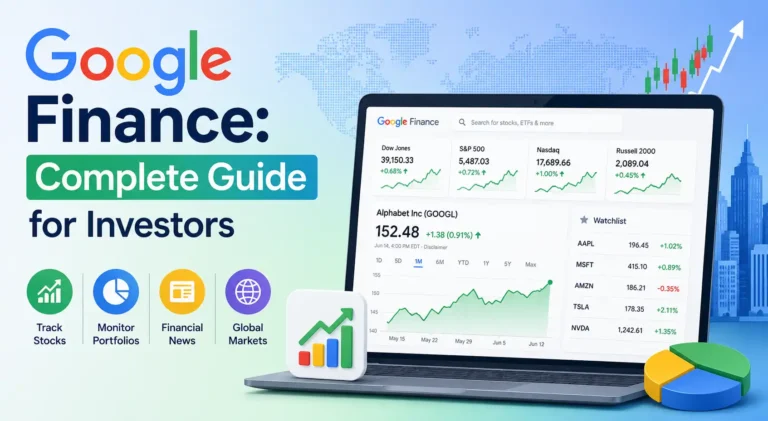
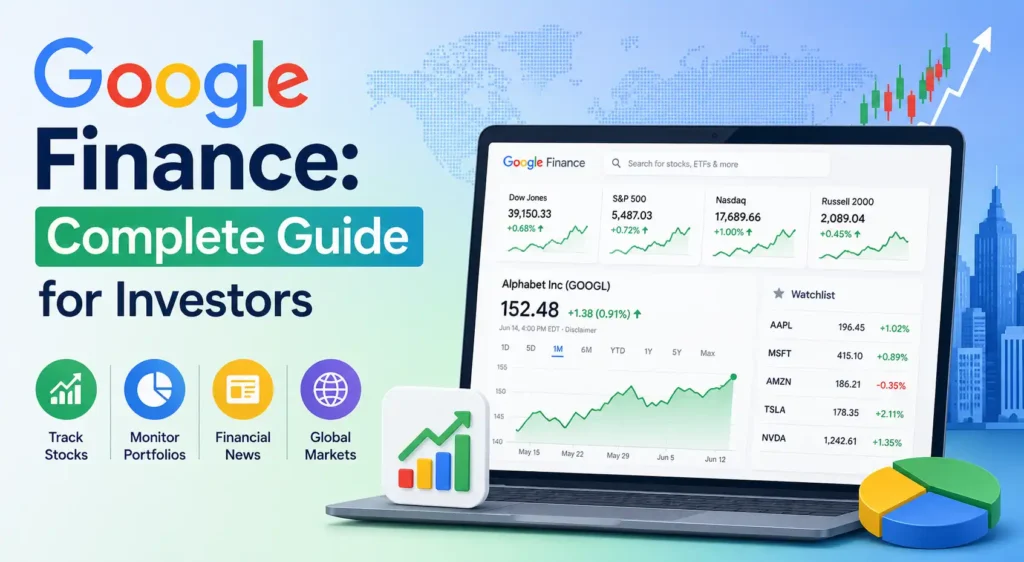
Google Finance is a free financial information platform developed by Google that helps investors, traders, and market enthusiasts monitor stocks, ETFs, mutual funds, market indexes, and investment portfolios from a single dashboard. Originally launched in 2006, the platform has evolved into a streamlined market-tracking tool that combines stock data, portfolio management, and financial news. Users can access market insights from major exchanges worldwide, including the NYSE, NASDAQ, and international markets. Because it integrates with a Google account, Google Finance allows personalized tracking of investments while providing quick access to company performance, market trends, and relevant financial news, making research faster and more convenient.
Key Features of Google Finance
Real-Time Market Data and Stock Tracking
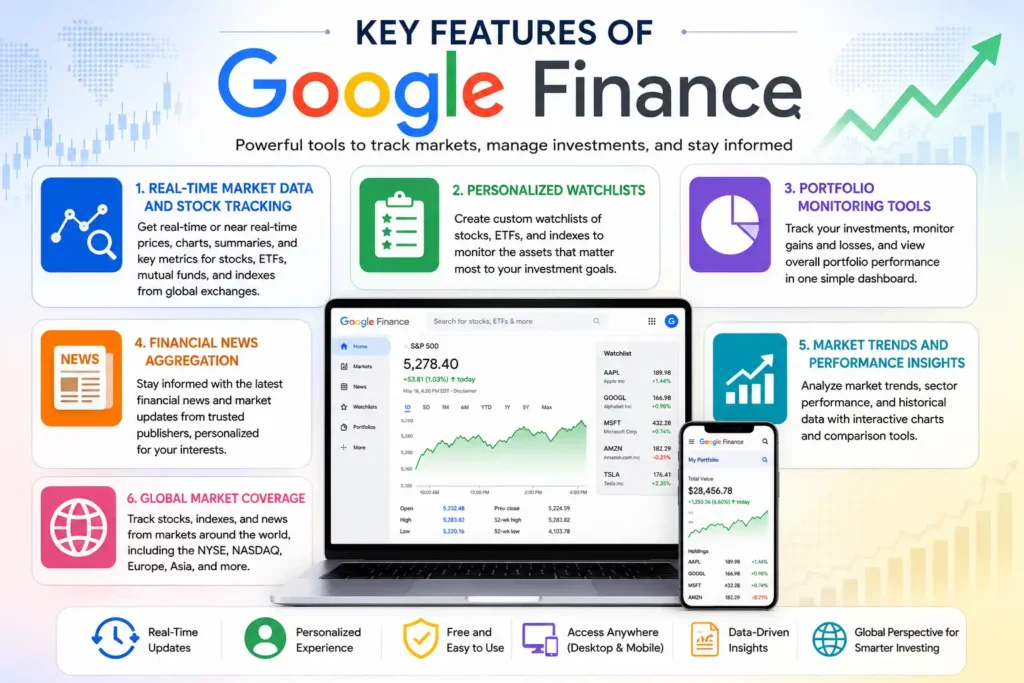
Google Finance provides near real-time market information for thousands of publicly traded companies, ETFs, mutual funds, and market indexes. Investors can quickly monitor price movements, daily gains and losses, trading volume, market capitalization, and other important metrics. The platform delivers data from major global exchanges, helping users stay informed about market activity. By presenting information in a clean and easy-to-understand format, Google Finance enables investors to identify trends and react more efficiently to changing market conditions.
Personalized Watchlists
The watchlist feature allows users to create a customized collection of stocks, ETFs, and other securities they want to monitor regularly. Instead of searching for individual assets each day, investors can view all selected holdings in one place. This personalized approach helps investors focus on the assets that matter most to their financial goals and investment strategies.
Portfolio Monitoring Tools
Google Finance includes portfolio tracking capabilities that allow users to record their investments and evaluate performance over time. Investors can add holdings, update transaction details, and monitor gains or losses across multiple assets. The platform automatically calculates portfolio value based on current market prices, helping users understand how their investments are performing. This feature is particularly useful for long-term investors who want a centralized view of their assets without relying solely on brokerage account dashboards.
Financial News Aggregation
One of the most valuable features of Google Finance is its ability to aggregate financial news from trusted publishers across the web. Users receive personalized news stories related to their watchlists, portfolios, and broader market interests. Research consistently shows that news events can significantly influence stock prices and investor sentiment. By combining market data with relevant headlines, Google Finance helps users stay informed about earnings reports, economic developments, corporate announcements, and industry trends that may affect investment decisions.
Market Trends and Performance Insights
Google Finance helps users understand broader market conditions through trend analysis and performance tracking tools. Investors can review how sectors, industries, and market indexes perform over different time periods. Historical charts and comparative data make it easier to identify growth patterns, market cycles, and momentum shifts. These insights support better decision-making by providing context beyond individual stock performance. Understanding market trends is particularly important because long-term investment success often depends on recognizing broader economic and sector-level movements.
Global Market Coverage
Modern investors increasingly diversify across international markets, and Google Finance supports this approach through extensive global coverage. Users can follow stocks, indexes, and financial news from North America, Europe, Asia-Pacific, and other major regions. This worldwide perspective helps investors monitor global economic developments that may influence portfolio performance. Whether tracking U.S. technology companies, European manufacturers, or Asian market indexes, Google Finance provides a centralized platform for analyzing international investment opportunities and market activity.
💚 You Might Also Like: URLwo: Complete Guide to URL Management Platform
How to Access and Set Up Google Finance
Accessing Google Finance on Desktop and Mobile
Getting started with Google Finance is simple because the platform is available through any modern web browser. Users can access it from desktops, laptops, tablets, and smartphones without installing specialized software. The mobile-friendly interface ensures that investors can check market movements and portfolio performance while traveling or away from their primary devices. This accessibility makes Google Finance a convenient option for monitoring investments and staying connected to financial markets throughout the day.
Signing In with a Google Account
Although basic market information is available to everyone, signing in with a Google account unlocks personalized features such as watchlists and portfolio tracking. The login process takes only a few moments and synchronizes financial data across devices. Once authenticated, users can save preferences, create custom investment lists, and receive tailored financial news. Using a single Google account also ensures that investment information remains accessible whenever users switch between desktop and mobile devices.
Navigating the Dashboard
The Google Finance dashboard is designed to present important financial information in a clean and organized layout. Users can quickly view market summaries, watchlists, portfolio performance, trending stocks, and financial news from one screen. Navigation is straightforward, allowing investors to move between market categories, company profiles, and portfolio sections with minimal effort. This user-friendly structure reduces information overload while helping investors focus on the data most relevant to their investment objectives.
Customizing Watchlists
Creating a personalized watchlist is one of the first steps many investors take after setting up Google Finance. Users can add stocks, ETFs, indexes, and other securities they wish to follow closely. The platform automatically updates pricing information and performance metrics throughout the trading day. Custom watchlists make it easier to compare investments, monitor opportunities, and track market activity without repeatedly searching for individual securities, improving both efficiency and investment awareness.
Personalizing Market Preferences
Google Finance allows users to tailor their experience by selecting preferred markets, investment interests, and financial topics. This customization helps investors focus on industries, sectors, or geographic regions that align with their strategies. By filtering out irrelevant information, users can spend more time analyzing meaningful market developments and less time sorting through unnecessary content.
How to Track Stocks and Market Performance with Google Finance
Searching for Stocks, ETFs, and Indexes
Google Finance offers a powerful search function that helps users locate stocks, exchange-traded funds, mutual funds, and market indexes within seconds. Simply entering a company name or ticker symbol provides access to pricing data, company information, financial statistics, and recent news. This feature simplifies investment research and allows investors to evaluate opportunities quickly. Whether researching a large-cap company or a niche ETF, users can access relevant information through a single search interface.
Monitoring Price Movements
Tracking price changes is one of the core functions of Google Finance. Investors can view current prices, daily performance, percentage changes, and historical movement data in real time. Monitoring these fluctuations helps users identify trends, evaluate market sentiment, and assess investment opportunities.
Reading Stock Charts
Google Finance includes interactive charts that visually display historical stock performance across multiple time frames. Investors can analyze short-term volatility or long-term growth patterns using daily, monthly, yearly, and multi-year views. Charts help identify support levels, resistance zones, and overall market direction. Visual analysis often reveals trends that may not be immediately apparent from numerical data alone, making chart interpretation an essential skill for investors using the platform.
Comparing Multiple Securities
Investors frequently compare assets before making investment decisions, and Google Finance simplifies this process through side-by-side comparisons. Users can evaluate multiple stocks, ETFs, or indexes based on price performance and historical trends. Comparative analysis helps investors identify stronger opportunities, assess risk levels, and understand relative market performance. This feature is particularly valuable when choosing between similar investments within the same sector or industry.
Tracking Sector and Industry Performance
Sector analysis provides important context for understanding stock performance. Google Finance allows users to monitor industries such as technology, healthcare, finance, energy, and consumer goods. Evaluating sector performance helps investors identify areas experiencing growth or weakness. Since market leaders often emerge from strong-performing industries, tracking sector trends can improve investment research and support more informed portfolio allocation decisions over time.
Following Global Markets
Global financial markets are increasingly interconnected, making international monitoring essential for modern investors. Google Finance enables users to track major indexes and economic activity from markets around the world. Following global developments helps investors understand how geopolitical events, economic policies, and international trends may influence investment performance. A broader market perspective can uncover new opportunities while providing valuable context for evaluating domestic market movements.
💚 You Might Also Like: Google Shopping: Sell More Products on Google in 2026
Google Finance Portfolio Management Explained
Google Finance is more than a stock-tracking platform—it also serves as a practical portfolio management tool for investors who want a clear overview of their holdings. By creating customized portfolios, users can track investments, monitor performance, and analyze gains or losses without relying entirely on brokerage dashboards. The platform automatically updates asset values based on current market data, making portfolio monitoring more efficient. Whether managing a retirement account, long-term investment strategy, or diversified stock portfolio, Google Finance provides a centralized space to evaluate investment progress and make more informed financial decisions.
Creating an Investment Portfolio
Creating a portfolio in Google Finance is straightforward and requires only a Google account. Users can add stocks, ETFs, mutual funds, and other investments to build a personalized portfolio. This feature provides a consolidated view of holdings, helping investors monitor asset allocation and overall investment performance while maintaining a clear record of their financial positions.
Adding and Editing Holdings
Google Finance allows investors to add holdings manually and update transaction details whenever changes occur. Users can edit purchase prices, share quantities, and transaction dates to maintain accurate portfolio records. Keeping investment data updated ensures that performance calculations remain reliable and reflect the current status of each holding.
Tracking Gains and Losses
One of the most useful portfolio features is the ability to monitor gains and losses automatically. Google Finance compares current market prices with purchase values to calculate investment performance. This allows investors to evaluate profitable positions, identify underperforming assets, and better understand how market fluctuations impact overall portfolio value.
Measuring Portfolio Performance
Performance measurement helps investors determine whether their strategy is producing desired results. Google Finance provides portfolio valuation and return tracking that can be monitored over different periods. By regularly reviewing portfolio performance, investors can assess growth trends, identify weaknesses, and make adjustments that align with long-term financial objectives.
Organizing Multiple Portfolios
Many investors manage separate portfolios for retirement savings, dividend investing, growth stocks, or education funds. Google Finance supports multiple portfolio creation, making it easier to organize investments by strategy or goal. This separation provides clearer performance analysis and simplifies tracking across different investment categories.
Best Practices for Portfolio Monitoring
Successful portfolio management requires consistent monitoring and periodic review. Investors should update holdings regularly, track diversification levels, and evaluate performance against financial goals. Reviewing portfolios monthly rather than reacting to daily market noise often leads to better long-term decision-making and helps maintain a disciplined investment strategy.
Google Finance vs Other Investment Tracking Platforms
| Feature | Google Finance | Yahoo Finance | TradingView | MarketWatch | Brokerage Platforms |
| Primary Focus | Portfolio Tracking & Market Monitoring | Financial Research & Data | Technical Analysis & Charting | Financial News & Insights | Trading & Portfolio Management |
| Portfolio Tracking | ✅ Excellent | ✅ Good | ✅ Good | ⚠️ Basic | ✅ Advanced |
| Charting Tools | Basic | Moderate | Advanced | Basic | Advanced |
| Financial News | Personalized News Feed | Extensive Coverage | Limited | Comprehensive Coverage | Varies by Platform |
| Best For | Beginners & Long-Term Investors | Research-Focused Investors | Active Traders | News-Oriented Investors | Active Investors & Traders |
Benefits of Google Finance
Google Finance remains popular because it combines accessibility, simplicity, and essential market information in a single platform. Unlike many financial websites filled with complex analytics, Google Finance focuses on delivering the data most investors need without overwhelming them. Its integration with the broader Google ecosystem further enhances usability, allowing seamless access across devices. Whether someone is new to investing or managing a long-term portfolio, the platform provides practical tools for monitoring markets, tracking investments, and staying informed about financial developments. These benefits make it a valuable resource for a wide range of investors.
Advantages for Beginners
New investors often appreciate Google Finance because of its simple interface and easy-to-understand data presentation. The platform removes much of the complexity associated with financial analysis, allowing beginners to learn market fundamentals, monitor investments, and build confidence without feeling overwhelmed by advanced tools and terminology.
Benefits for Long-Term Investors
Long-term investors can use Google Finance to track portfolio performance, monitor market trends, and stay informed about holdings over extended periods. The platform supports disciplined investing by providing clear visibility into investment progress while reducing distractions often associated with short-term market speculation.
User-Friendly Interface Strengths
One of Google Finance’s greatest strengths is its clean and intuitive design. Information is organized logically, making navigation easy for users of all experience levels. Investors can quickly locate stock data, portfolio details, and financial news without spending excessive time searching through complicated menus.
Tips & Best Practices
To get the most value from Google Finance, investors should maintain updated portfolio information and review performance regularly. Creating customized watchlists helps prioritize important investments while reducing information overload. Investors should also use financial news alongside market data to gain a broader context before making decisions. Comparing stocks, sectors, and indexes can improve research quality and support smarter investment choices. Most importantly, Google Finance should be viewed as a research and monitoring tool rather than the sole basis for investment decisions, ensuring a more balanced and informed investing approach.
FAQs
Is Google Finance Free to Use?
Yes, Google Finance is completely free to use. Anyone can access stock quotes, market data, financial news, and investment tracking tools without paying a subscription fee. Users only need a Google account to unlock features such as watchlists and portfolio tracking. This makes Google Finance an attractive option for investors seeking reliable market information without the cost associated with premium financial platforms.
How Accurate Is Google Finance Stock Data?
Google Finance provides highly reliable market data sourced from major financial exchanges and data providers. While most prices are updated in near real-time, some exchanges may provide delayed quotes depending on licensing agreements. For general investment research and portfolio monitoring, the data is considered accurate and trustworthy. However, professional traders often verify information through brokerage platforms that offer direct exchange feeds and real-time execution data.
Can Google Finance Track My Investment Portfolio?
Yes, Google Finance includes portfolio tracking features that allow users to create and manage investment portfolios. The platform automatically calculates portfolio value and performance based on current market prices. This makes it easier to monitor investments, evaluate returns, and track financial progress over time.
Does Google Finance Provide Real-Time Stock Prices?
Google Finance provides real-time or near-real-time stock prices for many securities, depending on the exchange and data availability. Major U.S. stocks often receive frequent updates throughout trading hours. However, some international markets may display delayed data due to exchange-specific regulations. Investors should review the timestamp displayed with each quote to understand the freshness of the information provided.
How Do I Use Google Finance With Google Sheets?
Google Sheets integrates with Google Finance through the GOOGLEFINANCE function. This feature allows users to pull stock prices, historical data, currency exchange rates, and market information directly into spreadsheets. Investors commonly use it to build custom portfolio trackers, monitor performance, and automate financial analysis. The integration offers a flexible solution for users who want more detailed reporting and investment calculations.
Is Google Finance Suitable for Beginner Investors?
Google Finance is one of the most beginner-friendly financial platforms available today. Its clean interface, straightforward navigation, and easy-to-understand market data make it ideal for individuals new to investing. Beginners can learn how markets work, create watchlists, follow financial news, and track investments without dealing with the complexity often found on professional trading platforms.
Can I Track International Stocks on Google Finance?
Yes, Google Finance supports a wide range of international stocks, indexes, and exchange-traded funds from major markets around the world. Investors can follow companies listed in North America, Europe, Asia, and other regions. This global coverage helps users monitor international opportunities, diversify portfolios, and stay informed about worldwide market developments from a single platform.
What Are the Best Alternatives to Google Finance?
Several alternatives offer additional features depending on investor needs. Yahoo Finance provides extensive company fundamentals and analyst insights. TradingView is known for advanced charting and technical analysis tools. MarketWatch delivers comprehensive financial news and market commentary. Brokerage platforms offer integrated trading capabilities. The best choice depends on whether an investor prioritizes simplicity, research depth, technical analysis, or active trading functionality.
💚 You Might Also Like: Google Slides: Create Professional Presentations in 2026
Conclusion
Google Finance has established itself as one of the most accessible and user-friendly investment tracking platforms available. It combines market data, portfolio management tools, personalized watchlists, and financial news into a single, streamlined experience. Whether you are a beginner learning about investing or a long-term investor monitoring portfolio performance, the platform provides valuable insights without unnecessary complexity. While advanced traders may require specialized charting or brokerage tools, Google Finance remains an excellent resource for tracking stocks, researching market trends, and staying informed about global financial markets. Its simplicity, reliability, and free accessibility continue to make it a preferred choice for millions of investors worldwide.
✨ Want more clarity, less confusion? Follow Milyom.