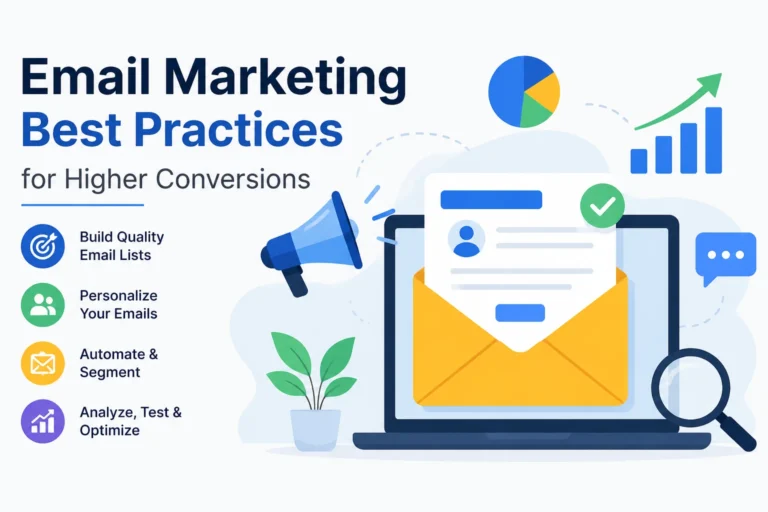
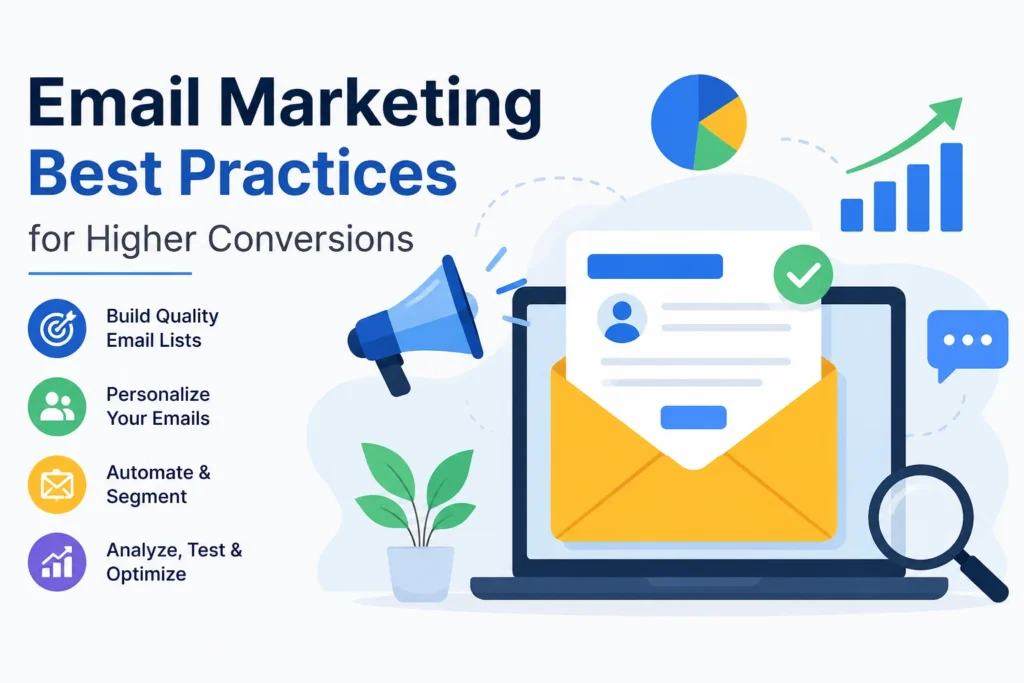

Email Marketing Best Practices for Higher Conversions
Email marketing remains one of the most profitable digital marketing strategies because it gives businesses direct access to their audience without relying on changing social media algorithms. Instead of competing for visibility, brands communicate with subscribers who have already shown interest. According to the Data & Marketing Association (DMA), email marketing can generate an average return of around $36 for every $1 spent, making it one of the highest-ROI marketing channels available. When combined with personalization, segmentation, and automation, email helps businesses build trust, nurture leads, and consistently drive higher conversions throughout every stage of the customer journey.
What Email Marketing Means in Modern Digital Marketing
It involves delivering personalized, timely, and relevant messages based on customer behavior, preferences, and purchase history. Businesses use email to educate prospects, nurture leads, recover abandoned carts, promote products, and strengthen customer relationships. Today’s successful email campaigns rely on automation, audience segmentation, and data-driven optimization to maximize engagement and conversions.
Why Email Continues to Outperform Other Marketing Channels
Unlike social media platforms, where algorithm changes can reduce organic reach overnight, email gives businesses complete ownership of their audience. Research from Litmus and DMA consistently shows email delivers one of the highest returns on investment among digital channels. Since subscribers willingly join email lists, engagement rates are generally stronger, resulting in higher open rates, click-through rates, and sales than many paid advertising campaigns.
Key Benefits of Email Marketing for Businesses
Email marketing helps businesses generate qualified leads, increase repeat purchases, improve customer loyalty, and reduce customer acquisition costs. It also provides measurable performance metrics such as open rates, click-through rates, conversions, and revenue generated from each campaign. With affordable automation tools, businesses of every size can scale personalized communication while maintaining strong customer relationships and long-term profitability.
How Email Marketing Supports the Customer Journey
Email marketing supports every stage of the customer journey, from awareness to long-term retention. Welcome emails introduce new subscribers, educational emails build trust, promotional campaigns encourage purchases, and post-purchase emails improve customer satisfaction. Re-engagement campaigns help recover inactive subscribers, while loyalty emails strengthen long-term relationships. This continuous communication keeps customers engaged and increases lifetime value over time.
Building a High-Quality Email List the Right Way
A successful email marketing strategy starts with building a high-quality subscriber list instead of chasing large numbers. A smaller audience filled with genuinely interested subscribers almost always outperforms a massive list of inactive contacts. Search engines and email providers both value engagement, making list quality essential for long-term success. By focusing on permission-based subscriptions, valuable lead magnets, optimized signup forms, and ethical collection methods, businesses create healthier email lists that produce higher open rates, better click-through rates, stronger customer relationships, and significantly higher conversions over time.
Why Organic Email List Growth Matters
Organic email list growth attracts subscribers who genuinely want your content instead of people added through purchased lists. These subscribers are more likely to open emails, click links, and become loyal customers. Organic growth also protects sender reputation, reduces spam complaints, and improves overall email deliverability, helping future campaigns consistently reach subscribers’ inboxes.
Best Lead Magnet Ideas That Increase Signups
High-value lead magnets encourage visitors to exchange their email addresses for useful resources. Popular options include ebooks, industry reports, exclusive discounts, free templates, webinars, checklists, product trials, and educational email courses. The most effective lead magnets solve a specific problem immediately, giving subscribers a compelling reason to join your email list and remain engaged.
Creating High-Converting Opt-In Forms
A high-converting opt-in form should be simple, visually appealing, and easy to complete. Request only essential information, use compelling headlines, clearly explain the value subscribers will receive, and include a strong call-to-action. Mobile-friendly forms, trust signals, and strategic design improvements can significantly increase signup rates while reducing unnecessary friction during the registration process.
Where to Place Signup Forms for Maximum Results
Strategic placement dramatically affects conversion rates. Effective locations include homepage hero sections, blog posts, landing pages, exit-intent popups, sticky headers, sidebars, checkout pages, and resource pages. Testing different placements helps identify where visitors are most willing to subscribe, allowing businesses to maximize list growth without negatively affecting the user experience.
Email List Building Mistakes to Avoid
Avoid buying email lists, requesting unnecessary information, hiding unsubscribe options, or sending emails without permission. These practices damage sender reputation and increase spam complaints. Businesses should also regularly remove inactive subscribers, verify email addresses, and comply with privacy regulations. A clean, permission-based list consistently performs better than a larger, low-quality database.
Understanding Your Audience Through Email Segmentation
Email segmentation allows marketers to deliver more relevant messages by dividing subscribers into meaningful groups based on shared characteristics or behaviors. Instead of sending identical emails to everyone, segmentation ensures each audience receives content that matches their interests and buying stage. Research from Mailchimp consistently shows segmented campaigns achieve higher open rates, stronger click-through rates, and improved revenue compared to non-segmented campaigns. Understanding your audience enables better personalization, stronger engagement, and more efficient marketing campaigns that convert at significantly higher rates.
What Email Segmentation Is and Why It Matters
Email segmentation organizes subscribers into targeted groups based on demographics, interests, behaviors, engagement levels, or purchase history. This allows businesses to deliver highly relevant content instead of generic messages. Personalized communication improves customer experience, increases engagement, and reduces unsubscribe rates while helping marketers achieve stronger campaign performance and better conversion results.
Demographic and Behavioral Segmentation
Demographic segmentation groups subscribers using factors such as age, gender, location, occupation, or industry. Behavioral segmentation focuses on customer actions, including website visits, email engagement, purchases, browsing history, and product interests. Combining both methods creates highly targeted campaigns that deliver personalized experiences and significantly improve customer engagement.
Purchase History and Customer Lifecycle Segmentation
Analyzing purchase history helps businesses recommend relevant products, reward loyal customers, and encourage repeat purchases. Lifecycle users. Sending emails based on each stage of the customer journey improves relevance while increasing retention, loyalty, and overall customer lifetime value.
Creating Personalized Customer Segments
Effective customer segments combine multiple data points rather than relying on one characteristic alone. Businesses can create segments using buying behavior, email engagement, website activity, geographic location, preferences, and purchase frequency. Modern email platforms use AI and automation to continuously update segments, ensuring subscribers always receive relevant content based on their latest interactions.
Benefits of Targeted Email Campaigns
Targeted email campaigns consistently outperform mass email blasts because subscribers receive information aligned with their interests. Higher relevance leads to increased open rates, stronger click-through rates, better customer satisfaction, and more conversions. Businesses also experience fewer spam complaints, lower unsubscribe rates, and greater overall return on their email marketing investment.
You might also like: Most Profitable Small Business Ideas for Beginners
Writing High-Converting Emails That Get Opened and Clicked
Even the most advanced email strategy fails without compelling content that motivates subscribers to take action. High-converting emails combine persuasive copywriting, engaging subject lines, strong calls-to-action, and clean design to capture attention quickly. Every element should guide readers naturally toward a desired goal, whether purchasing a product, downloading a resource, or scheduling a consultation. By focusing on clarity, relevance, personalization, and user experience, businesses create emails that consistently increase open rates, click-through rates, customer engagement, and overall conversion performance.
Crafting Attention-Grabbing Subject Lines
Subject lines determine whether subscribers open an email or ignore it. Effective subject lines remain clear, concise, and curiosity-driven without appearing misleading. Using personalization, urgency, numbers, or benefit-focused language often improves performance. A/B testing multiple subject line variations helps marketers identify patterns that consistently increase email open rates across different audience segments.
Writing Engaging Preview Text
Preview text acts as a second headline by expanding on the subject line before recipients open the email. Well-written preview text creates curiosity, highlights value, and encourages clicks. Avoid repeating the subject line exactly. Instead, provide additional context that reinforces the message and motivates subscribers to learn more by opening the email.
Creating Valuable Email Copy
Successful email copy focuses on solving customer problems rather than promoting products aggressively. Use conversational language, short paragraphs, clear benefits, and persuasive storytelling to maintain attention. Every sentence should move readers closer to taking action while providing genuine value. Relevant content builds trust and increases long-term engagement with future email campaigns.
Using Persuasive Calls-to-Action (CTAs)
A strong call-to-action clearly tells readers what to do next using action-oriented language such as “Start Your Free Trial,” “Download the Guide,” or “Shop Now.” Limit distractions by focusing on one primary CTA whenever possible. Visible buttons, compelling copy, and strategic placement significantly improve click-through and conversion rates.
Email Design Best Practices for Better Readability
An effective email design prioritizes readability across all devices. Use responsive layouts, sufficient white space, clear headings, accessible fonts, and optimized images. Keep paragraphs short and ensure CTA buttons are easy to tap on mobile devices. Since most marketing emails are now opened on smartphones, mobile-first design is essential for maximizing engagement and conversions.
Personalization Strategies That Increase Email Conversions
Personalization has evolved far beyond simply inserting a subscriber’s first name into an email. Today’s consumers expect brands to understand their interests, preferences, and buying behavior while delivering highly relevant experiences. According to research from McKinsey & Company, companies that excel at personalization can generate significantly higher revenue and stronger customer loyalty than those relying on generic messaging. By combining customer data, behavioral insights, AI-driven recommendations, and marketing automation, businesses can create highly personalized email campaigns that improve engagement, increase click-through rates, strengthen customer relationships, and drive consistently higher conversion rates.
Beyond Using the Customer’s First Name
Adding a subscriber’s first name is only the beginning of effective personalization. Modern email marketing uses browsing history, purchase behavior, location, preferences, and previous interactions to deliver highly relevant content. Customers are more likely to engage when emails reflect their interests and current needs rather than relying on simple name personalization alone.
Dynamic Content and Personalized Recommendations
Dynamic content automatically changes sections of an email based on subscriber data. Businesses can display personalized product recommendations, local offers, recently viewed items, or customized promotions for each recipient. This approach creates a more relevant experience that encourages higher engagement while increasing the likelihood of clicks, purchases, and repeat customer activity.
Behavioral Trigger Emails That Convert
Behavioral trigger emails are automatically sent after specific customer actions, such as signing up for a newsletter, abandoning a shopping cart, viewing a product, or completing a purchase. Because these emails are timely and highly relevant, they consistently outperform standard promotional campaigns by generating higher open rates, click-through rates, and conversions.
AI-Powered Personalization Techniques
Artificial intelligence helps marketers analyze customer behavior, predict future interests, and deliver personalized experiences at scale. AI can recommend products, optimize send times, generate subject lines, segment audiences automatically, and predict purchase intent. These capabilities improve campaign relevance while reducing manual work and increasing overall marketing efficiency.
Common Personalization Mistakes
Overusing customer data, sending irrelevant recommendations, or relying on outdated subscriber information can damage trust and reduce engagement. Businesses should regularly update customer profiles, respect privacy preferences, avoid excessive personalization, and ensure recommendations genuinely match subscriber interests. Effective personalization always improves the customer experience rather than making it feel intrusive.
You might also like: 5 Best Email Marketing Platforms for Growth (2026)
Email Automation Best Practices for Maximum ROI
Email automation enables businesses to deliver the right message to the right person at exactly the right moment without requiring constant manual effort. Automated campaigns improve efficiency while maintaining consistent communication throughout the customer journey. According to Campaign Monitor, automated emails often generate significantly higher open rates and click-through rates than standard bulk campaigns because they are behavior-driven and highly relevant. When combined with segmentation and personalization, automation helps businesses nurture leads, increase sales, improve retention, and maximize return on investment through continuous customer engagement.
Welcome Email Series
A welcome email series creates the first impression after someone joins your email list. Instead of sending a single email, businesses should introduce their brand through multiple messages that explain company values, highlight popular products, share educational resources, and encourage subscribers to take their first meaningful action. Strong onboarding improves long-term engagement.
Abandoned Cart Email Automation
Abandoned cart emails remind shoppers to complete purchases they left unfinished. Including product images, customer reviews, limited-time discounts, or urgency messages often increases recovery rates. Research from multiple ecommerce platforms shows abandoned cart automation consistently delivers some of the highest conversion rates among all automated email campaigns.
Lead Nurturing Email Sequences
Lead nurturing sequences educate potential customers over time by delivering valuable content instead of immediate sales pitches. Educational articles, case studies, product demonstrations, and success stories gradually build trust and credibility. This approach keeps prospects engaged while moving them naturally through the sales funnel toward becoming paying customers.
Re-Engagement Campaigns for Inactive Subscribers
Subscribers naturally become inactive over time, making re-engagement campaigns essential for maintaining list quality. These campaigns often include exclusive offers, updated content, surveys, or personalized recommendations designed to regain attention. If subscribers remain inactive, removing them helps improve engagement metrics and protects overall sender reputation.
Post-Purchase Follow-Up Emails
Post-purchase emails strengthen customer relationships after a sale by providing order confirmations, shipping updates, product usage tips, review requests, and personalized recommendations. These emails improve customer satisfaction while encouraging repeat purchases, referrals, and long-term loyalty. Effective follow-up communication increases customer lifetime value and strengthens overall brand trust.
You might also like: Best Content Marketing Tools for Growth in 2026
Optimizing Email Deliverability and Avoiding Spam Filters
Creating outstanding email content is meaningless if messages never reach subscribers’ inboxes. Email deliverability measures the ability of emails to successfully bypass spam filters and appear in the primary inbox. Internet service providers evaluate numerous trust signals before deciding where emails should be delivered. Businesses that maintain clean email lists, authenticate their domains, follow privacy regulations, and consistently send valuable content achieve stronger inbox placement. Prioritizing deliverability ensures marketing campaigns reach real customers, improving engagement, protecting sender reputation, and maximizing conversion opportunities.
How Email Deliverability Works
Email providers evaluate sender reputation, authentication records, engagement levels, spam complaints, bounce rates, and content quality before deciding whether emails belong in the inbox or spam folder. Positive subscriber interactions, consistent sending behavior, and high-quality email lists improve deliverability, ensuring more campaigns successfully reach their intended audience.
Authentication (SPF, DKIM, and DMARC)
SPF, DKIM, and DMARC authenticate your sending domain and verify that emails originate from authorized servers. These authentication protocols help prevent spoofing, phishing attacks, and email fraud while increasing trust with mailbox providers. Proper authentication significantly improves inbox placement and protects brand credibility across email communications.
Maintaining a Healthy Sender Reputation
Sender reputation reflects how trustworthy email providers consider your domain and IP address. Consistently sending relevant content, maintaining low complaint rates, removing inactive subscribers, and avoiding spammy tactics help build a positive reputation. A strong sender reputation directly increases inbox placement and long-term email marketing success.
Reducing Bounce Rates and Spam Complaints
Regularly cleaning email lists, validating addresses, and collecting subscribers through permission-based methods reduce bounce rates and spam complaints. Businesses should avoid purchased email lists and remove invalid or inactive contacts. Better list hygiene improves engagement metrics while strengthening deliverability and overall campaign performance.
Email Compliance (GDPR, CAN-SPAM, and Privacy Laws)
Email marketers must comply with regulations such as GDPR, CAN-SPAM, and other privacy laws depending on their target markets. Businesses should obtain subscriber consent, provide clear unsubscribe options, protect customer data, and communicate transparently. Following legal requirements builds trust while reducing compliance risks and protecting brand reputation.
A/B Testing and Performance Optimization Techniques
Successful email marketing depends on continuous improvement rather than assumptions. A/B testing allows marketers to compare two versions of an email and determine which performs better using real subscriber data. Small changes in subject lines, call-to-action buttons, email layouts, or sending times can significantly influence engagement and conversions. By consistently testing different campaign elements and analyzing performance metrics, businesses make data-driven decisions that improve results over time. Continuous optimization transforms average email campaigns into highly effective marketing assets that generate stronger engagement and increased revenue.
What Elements Should Be A/B Tested
Nearly every component of an email campaign can be tested, including subject lines, preview text, sender names, images, headlines, CTA buttons, layouts, personalization, and email length. Testing one variable at a time produces accurate results and helps marketers understand exactly which changes influence subscriber behavior and campaign performance.
Testing Subject Lines and Email Content
Subject lines have one of the greatest impacts on open rates, making them ideal for A/B testing. Businesses should also test email copy, content structure, images, personalization, and CTA placement. Comparing different versions reveals which messaging resonates most effectively with the target audience and drives stronger conversions.
Optimizing Send Time and Frequency
The best send time varies depending on audience behavior, industry, and geographic location. Testing different days, times, and sending frequencies helps identify when subscribers are most active. Businesses should balance consistency with subscriber preferences to maximize engagement while avoiding email fatigue and unnecessary unsubscribe requests.
Measuring Statistical Significance
Reliable A/B testing requires sufficient sample sizes and statistically significant results rather than random outcomes. Marketers should allow tests to run long enough before selecting a winner. Using accurate performance data prevents incorrect conclusions and ensures optimization decisions produce measurable improvements in future email campaigns.
Continuous Optimization Strategies
Optimization should be an ongoing process instead of a one-time activity. Regularly analyze open rates, click-through rates, conversions, unsubscribe rates, and customer feedback to identify improvement opportunities. Combining testing, analytics, personalization, and automation allows businesses to continuously refine their email marketing strategy and achieve sustainable long-term growth.
You might also like: Low Investment Business Ideas to Start in 2026
Measuring Email Marketing Success with the Right KPIs
Measuring email marketing performance is essential for understanding what works and where improvements are needed. Without tracking the right key performance indicators (KPIs), businesses rely on guesswork instead of data-driven decisions. Modern email platforms provide detailed analytics that reveal subscriber behavior, campaign effectiveness, and overall return on investment. According to Litmus, organizations that consistently analyze email metrics are better positioned to optimize future campaigns and maximize revenue. Monitoring the right KPIs helps marketers improve engagement, increase conversions, reduce costs, and build a sustainable email marketing strategy based on measurable business outcomes.
Email Open Rate
Email open rate measures the percentage of recipients who open an email after it reaches their inbox. While privacy updates have affected tracking accuracy, open rate still provides valuable insights into subject line effectiveness, sender reputation, and audience interest. Higher open rates generally indicate that subscribers find your emails relevant and trustworthy.
Click-Through Rate (CTR)
Click-through rate (CTR) measures the percentage of recipients who click one or more links within an email. It reflects how engaging your content, design, and calls-to-action are. A strong CTR indicates subscribers find your message valuable and are motivated to take the next step toward becoming customers or completing another desired action.
Conversion Rate
Conversion rate tracks how many recipients complete a desired action after clicking an email link, such as purchasing a product, registering for a webinar, or downloading a resource. This metric directly connects email marketing efforts to business objectives, making it one of the most important KPIs for measuring campaign success.
Bounce Rate and Unsubscribe Rate
Bounce rate indicates the percentage of emails that could not be delivered, while unsubscribe rate measures how many subscribers choose to leave your mailing list. High bounce or unsubscribe rates often signal poor list quality, irrelevant content, or excessive email frequency. Monitoring these metrics helps maintain a healthy email database.
Revenue Per Email and Overall ROI
Revenue per email measures how much income each email generates, while return on investment (ROI) compares campaign revenue with total marketing costs. These metrics help businesses evaluate profitability and allocate budgets more effectively. According to the Data & Marketing Association, email marketing continues to deliver one of the highest ROIs across all digital marketing channels.
Advanced Email Marketing Best Practices for Higher Conversions in 2026
Email marketing continues to evolve as artificial intelligence, automation, and customer expectations reshape digital communication. Businesses that embrace emerging technologies gain a competitive advantage by delivering more personalized, engaging, and data-driven experiences. Modern email strategies focus on predictive analytics, interactive content, mobile optimization, and seamless cross-channel communication. Rather than relying solely on traditional promotional emails, successful marketers build intelligent campaigns that adapt to customer behavior in real time. Following these advanced best practices helps improve engagement, strengthen customer relationships, and achieve consistently higher conversion rates throughout 2026 and beyond.
AI and Predictive Email Marketing
Artificial intelligence enables marketers to predict customer behavior, automate audience segmentation, recommend relevant products, and optimize send times. Predictive analytics identifies subscribers most likely to convert, allowing businesses to deliver personalized campaigns with greater precision. AI also reduces manual workload while improving campaign performance and overall marketing efficiency.
Interactive Emails and AMP Technology
Interactive emails allow subscribers to complete actions directly inside the email without visiting another webpage. AMP technology supports features such as appointment scheduling, product carousels, image galleries, surveys, and live content updates.
Mobile-First Email Design
Responsive layouts, readable fonts, optimized images, and touch-friendly buttons improve user experience across all screen sizes. Fast-loading emails with clear calls-to-action encourage higher engagement and better conversion performance on mobile devices.
Omnichannel Marketing Integration
Email marketing performs best when integrated with other digital channels such as social media, SMS, paid advertising, CRM platforms, and website personalization. Omnichannel marketing delivers a consistent customer experience across every touchpoint. This unified approach strengthens brand recognition, improves engagement, and increases the likelihood of customer conversions throughout the buying journey.
Final Checklist for High-Converting Email Campaigns
Before launching any campaign, verify that your email list is clean, audience segments are accurate, personalization is relevant, subject lines are compelling, CTAs are clear, mobile optimization is complete, authentication records are configured, and A/B testing has been performed. Reviewing this checklist before every campaign minimizes errors and maximizes conversion opportunities.
Conclusion
Email marketing remains one of the most effective digital marketing channels because it combines personalization, automation, and measurable performance into a single strategy. Businesses that focus on building permission-based email lists, segmenting audiences, creating valuable content, optimizing deliverability, and continuously testing campaigns consistently achieve stronger engagement and higher conversion rates. As AI, predictive analytics, and interactive email experiences continue to evolve, marketers who embrace these innovations will stay ahead of the competition. By implementing the best practices covered in this guide, you can build stronger customer relationships, maximize return on investment, and create email campaigns that deliver sustainable business growth in 2026 and beyond.
FAQs
What are email marketing best practices?
Email marketing best practices include building a permission-based email list, segmenting subscribers, personalizing content, using automation, writing compelling subject lines, optimizing for mobile devices, testing campaigns regularly, and monitoring key performance metrics to improve conversions.
Why is email marketing still effective in 2026?
Email marketing remains effective because businesses own their subscriber lists and communicate directly with interested audiences. Unlike social media algorithms, email provides consistent reach, high engagement, advanced personalization, and one of the highest returns on investment among digital marketing channels.
What is a good email open rate?
A good email open rate varies by industry, but many businesses consider 20% to 30% a strong benchmark. Factors such as audience quality, sender reputation, personalization, and subject line effectiveness all influence open rates.
How often should I send marketing emails?
The ideal email frequency depends on your audience and industry. Most businesses perform well with one to four emails per month, while ecommerce brands may send more frequent campaigns. Regular testing helps determine the frequency that maximizes engagement without causing subscriber fatigue.
Which email marketing metrics matter the most?
The most important metrics include email open rate, click-through rate (CTR), conversion rate, bounce rate, unsubscribe rate, revenue per email, and overall return on investment (ROI). Together, these KPIs provide a complete picture of campaign performance and business impact.
✨ Smart minds follow smart pages, hit follow on Milyom