
Introduction
Growing a business in 2026 is no longer just about offering a great product or service. Companies must also use the right technology to attract customers, improve efficiency, and stay ahead of competitors. Modern business growth tools help automate repetitive tasks, improve marketing performance, manage customer relationships, and streamline operations. According to research from the organization McKinsey & Company, businesses that effectively adopt digital technologies often achieve significantly higher productivity and revenue growth than those that do not. Whether you run a startup, small business, or expanding enterprise, choosing the right tools can create a strong foundation for sustainable growth and long-term success.
What Makes a Business Growth Tool Worth Using?
Not every business tool delivers meaningful results. The most valuable solutions help organizations save time, increase efficiency, and support long-term expansion without adding unnecessary complexity. A quality business growth tool should solve real challenges while integrating smoothly into existing workflows. As businesses become more dependent on digital operations, selecting tools that improve productivity and support scalability becomes increasingly important. The best platforms combine automation, analytics, and collaboration features to help teams make smarter decisions. Before investing in any software, it is essential to evaluate whether it aligns with your business goals, budget, and future growth strategy.
Key Features to Look For
A strong business growth tool should offer practical features that directly contribute to operational efficiency and revenue generation. Look for user-friendly interfaces, detailed reporting dashboards, customizable workflows, and reliable customer support. Data security is equally important, especially as businesses manage larger volumes of customer information. Cloud-based accessibility, mobile compatibility, and real-time insights can further enhance productivity and decision-making across departments.
Automation and Time-Saving Capabilities
Automation has become one of the most valuable features in modern business software. Repetitive tasks such as email follow-ups, data entry, lead nurturing, and reporting can consume countless hours each week. Automated workflows reduce manual effort, minimize human error, and allow teams to focus on strategic initiatives. Research from McKinsey suggests that many routine business activities can be partially automated using existing technologies.
Scalability for Growing Businesses
A business tool should support your company not only today but also as it grows. Scalable software can handle increasing customer data, larger teams, and more complex workflows without requiring a complete system replacement. Businesses that choose scalable solutions avoid costly migrations and operational disruptions later. Flexibility in pricing plans and feature upgrades is also an important indicator of long-term value.
Integration With Existing Business Systems
Modern businesses rely on multiple software platforms for sales, marketing, accounting, communication, and customer support. A growth tool becomes far more valuable when it integrates seamlessly with existing systems. Strong integrations eliminate data silos, improve workflow efficiency, and provide a centralized view of business performance. This connectivity helps teams collaborate more effectively while maintaining accurate and consistent information.
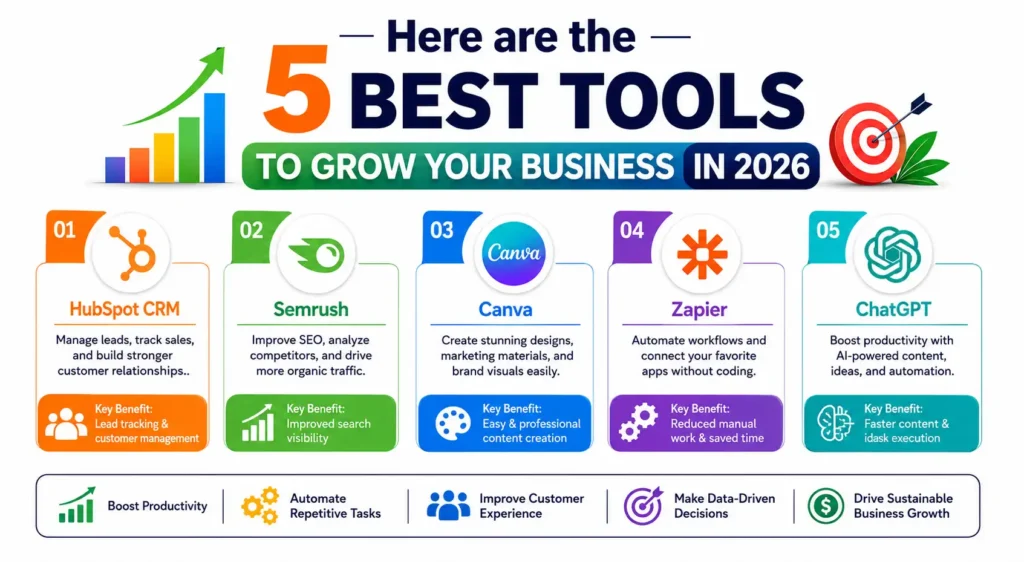
Here are the 5 Best Tools to Grow Your Business in 2026
HubSpot CRM
HubSpot CRM remains one of the most trusted customer relationship management platforms for businesses seeking sustainable growth in 2026. The software helps organizations organize contacts, track sales pipelines, automate follow-ups, and manage customer interactions from a single dashboard. One of its biggest advantages is accessibility, offering powerful functionality while remaining user-friendly for smaller teams. Businesses using CRM platforms often experience improved lead conversion and stronger customer retention due to better relationship management. HubSpot also integrates with marketing, customer service, and sales tools, creating a connected ecosystem that supports business expansion and improved customer experiences.
Key Features
HubSpot CRM provides contact management, sales pipeline tracking, email marketing automation, lead scoring, reporting dashboards, and customer communication tools. Users can monitor every customer interaction in one place while automating repetitive sales activities. The platform also offers extensive integrations with third-party applications, making it easier to create streamlined workflows and maintain consistent customer data across multiple business systems.
Semrush
In today’s digital-first environment, online visibility directly influences business growth. Semrush is one of the most comprehensive SEO and digital marketing platforms available, helping businesses increase website traffic, improve search rankings, and outperform competitors. The platform provides valuable insights into keyword opportunities, backlink profiles, content performance, and competitor strategies. Studies consistently show that organic search remains a major source of website traffic, making SEO an essential investment. By using Semrush, businesses can identify growth opportunities, optimize content, and develop data-driven marketing strategies that attract qualified visitors and generate long-term results.
Key Features
Semrush offers keyword research, competitor analysis, backlink auditing, rank tracking, site audits, content optimization tools, and advertising research features. Businesses can monitor search performance, discover new content opportunities, and identify technical SEO issues affecting visibility. Its extensive database and analytical capabilities make it a valuable resource for marketers, business owners, and SEO professionals focused on sustainable growth.
💚 You Might Also Like: 5 Best Writing Tools in 2026 for Better Content
Canva
Strong branding plays a critical role in business growth, and Canva has become one of the most popular design platforms for companies of all sizes. The platform enables users to create professional-quality graphics, presentations, social media content, marketing materials, and brand assets without advanced design skills. As visual content continues to dominate digital marketing channels, businesses need efficient ways to produce engaging designs consistently. Canva simplifies the design process through its drag-and-drop interface and extensive template library. Whether creating advertisements, email graphics, or promotional materials, Canva helps businesses maintain a professional brand presence while reducing design costs and production time.
Key Features
Canva offers thousands of customizable templates, a drag-and-drop editor, brand kits, AI-powered design tools, stock photos, video editing capabilities, and team collaboration features. Users can create consistent marketing assets across multiple channels while maintaining brand identity. Its cloud-based platform also enables teams to collaborate efficiently and access designs from anywhere.
Zapier
Businesses often use multiple software applications daily, creating repetitive tasks that can reduce productivity. Zapier solves this challenge by connecting different apps and automating workflows without requiring coding knowledge. The platform allows businesses to create automated processes, known as “Zaps,” that transfer data between applications and trigger actions automatically. According to productivity studies, automation can significantly reduce administrative workload and improve operational efficiency. By eliminating repetitive manual tasks, businesses can focus more on customer service, innovation, and growth initiatives. Zapier’s flexibility makes it particularly valuable for growing organizations that want to streamline operations without hiring additional staff.
Key Features
Zapier supports thousands of app integrations, workflow automation, multi-step automations, conditional logic, automated notifications, data synchronization, and task scheduling. Businesses can automate lead management, email marketing, customer support, and reporting processes. Its no-code approach makes advanced automation accessible to both technical and non-technical users.
💚 You Might Also Like: 5 Best Workforce Tools for Businesses in 2026
ChatGPT
Artificial intelligence is transforming how businesses operate, and ChatGPT has emerged as one of the most valuable AI-powered productivity tools available. Companies use ChatGPT to create content, generate ideas, automate customer support, draft emails, conduct research, and improve internal workflows. AI adoption continues to accelerate across industries because it helps teams complete tasks faster while maintaining quality. For small businesses and startups with limited resources, ChatGPT can function as a virtual assistant that supports marketing, sales, customer service, and operational tasks. Its versatility makes it a powerful solution for organizations seeking greater efficiency and scalable growth opportunities.
Key Features
ChatGPT provides content creation assistance, brainstorming support, customer communication drafting, research capabilities, workflow optimization, coding assistance, language translation, and knowledge management support. Businesses can use it to accelerate decision-making, improve productivity, and automate routine tasks. Its adaptability across departments makes it one of the most versatile business growth tools available today.
Comparison Table of the 5 Best Business Growth Tools
| Tool | Primary Purpose | Best For | Starting Cost | Key Benefit |
| HubSpot CRM | Customer Relationship Management | Sales Teams | Free Plan Available | Lead tracking and customer management |
| Semrush | SEO and Digital Marketing | Marketers | Paid Plans Available | Improved search visibility |
| Canva | Design and Branding | Marketing Teams | Free Plan Available | Easy content creation |
| Zapier | Workflow Automation | Growing Businesses | Free Plan Available | Reduced manual work |
| ChatGPT | AI Productivity | Businesses of All Sizes | Free and Paid Plans | Faster content and task execution |
*Pricing may change over time based on provider updates.
How to Choose the Right Tool for Your Business
Based on Business Size
Business size significantly influences software requirements. Startups and small businesses often benefit from affordable, easy-to-use solutions like Canva and ChatGPT. Mid-sized companies may require tools such as HubSpot CRM and Zapier to manage growing customer bases and workflows. Larger enterprises typically need scalable platforms with advanced automation, reporting, and integration capabilities to support complex operations and multiple teams.
Based on the industry
Different industries have unique growth challenges and operational needs. Service-based businesses often rely on CRM tools to manage client relationships, while e-commerce companies prioritize SEO and digital marketing solutions. Creative agencies frequently use design platforms like Canva, and technology-focused organizations may benefit from automation and AI tools. Selecting industry-relevant software improves efficiency and maximizes return on investment.
Based on the budget
Budget plays a crucial role when selecting business software. Many leading tools offer free plans or affordable entry-level packages that allow businesses to start small and scale gradually. Evaluate the expected return on investment rather than focusing solely on cost. A tool that improves efficiency, increases sales, or saves employee time may generate significantly greater value than its subscription price.
Based on Growth Goals
Your growth objectives should guide every software investment decision. Businesses focused on increasing sales may prioritize HubSpot CRM, while companies seeking more website traffic often benefit from Semrush. Organizations aiming to improve productivity can leverage ChatGPT and Zapier. Clearly defining growth goals helps ensure you choose tools that directly contribute to measurable business outcomes and long-term success.
5 Best Tips To Grow Your Business
Tip 1: Focus on Customer Experience
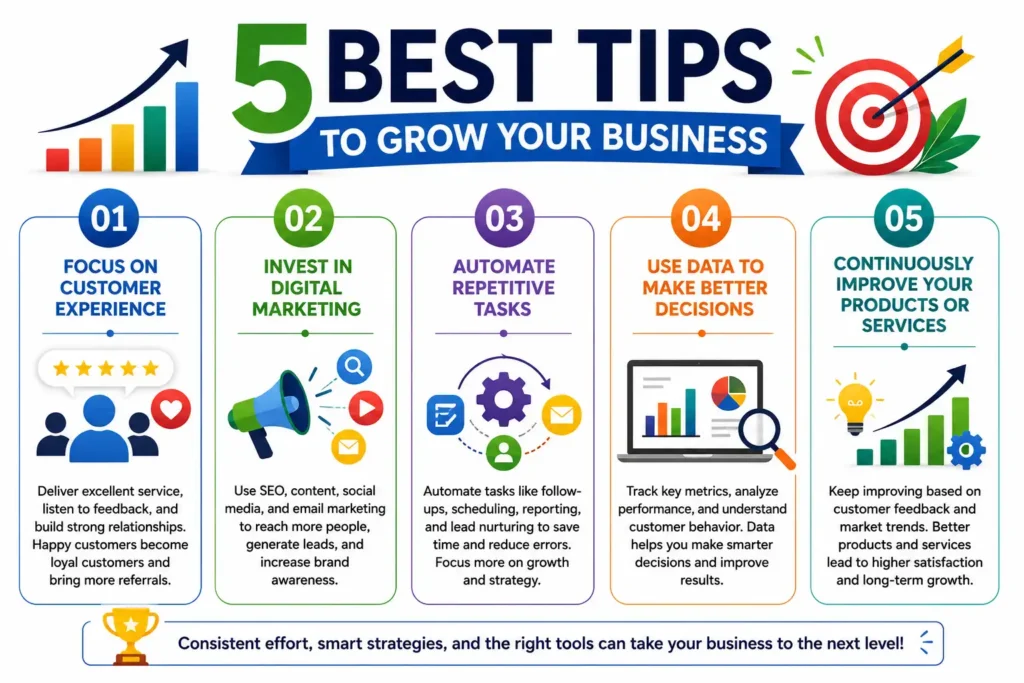
Customer experience remains one of the most important drivers of business growth. Companies that consistently deliver exceptional service often enjoy higher customer retention and stronger brand loyalty. Listen to customer feedback, resolve issues quickly, and personalize interactions whenever possible. Satisfied customers are more likely to become repeat buyers and recommend your business to others, helping generate sustainable growth through referrals and positive reviews.
Tip 2: Invest in Digital Marketing
A strong online presence is essential for reaching modern consumers. Invest in SEO, content marketing, social media, and email campaigns to attract qualified leads and increase brand awareness. Research consistently shows that businesses with effective digital marketing strategies generate more opportunities for growth. Focus on creating valuable content that addresses customer needs and builds trust with your target audience.
Tip 3: Automate Repetitive Tasks
Automation allows businesses to operate more efficiently by reducing manual work and minimizing errors. Tasks such as lead nurturing, appointment scheduling, reporting, and customer follow-ups can often be automated using tools like Zapier and HubSpot. By freeing employees from routine responsibilities, businesses can allocate more time to strategic activities that directly contribute to growth and profitability.
Tip 4: Use Data to Make Better Decisions
Successful businesses rely on data rather than assumptions. Monitor key performance indicators such as website traffic, conversion rates, customer acquisition costs, and sales performance. Analytics tools provide valuable insights into customer behavior and business trends. Regularly reviewing this information helps identify opportunities, improve marketing strategies, and make informed decisions that support long-term growth.
Tip 5: Continuously Improve Your Products or Services
Customer needs and market expectations constantly evolve. Businesses that regularly improve their products, services, and processes are better positioned to stay competitive. Gather customer feedback, monitor industry trends, and look for ways to add value. Continuous improvement not only increases customer satisfaction but also creates new opportunities for revenue growth and market expansion.
FAQs
What are the best tools to grow a business in 2026?
Some of the most effective business growth tools in 2026 include HubSpot CRM for customer management, Semrush for SEO, Canva for design and branding, Zapier for automation, and ChatGPT for AI-powered productivity. Each tool addresses a different aspect of business growth and can help improve efficiency, marketing performance, and customer engagement.
Which business growth tool is best for small businesses?
The best tool depends on the specific needs of the business. Small businesses often benefit from Canva for affordable marketing design, ChatGPT for content creation and productivity, and HubSpot CRM for managing customer relationships. These tools provide significant value while remaining accessible to companies with limited budgets.
Are business growth tools worth the investment?
Yes, business growth tools can provide a strong return on investment when used effectively. They help automate tasks, improve efficiency, generate leads, and enhance customer experiences. The time savings and increased productivity often outweigh subscription costs, making them valuable assets for businesses focused on growth.
Can I use multiple business tools together?
Absolutely. Many businesses combine several tools to create a complete growth ecosystem. For example, HubSpot CRM can manage customer data, Semrush can support SEO efforts, Canva can create marketing assets, Zapier can automate workflows, and ChatGPT can assist with content creation. Using complementary tools together often delivers better results than relying on a single platform.
How do I choose the right tool for my business?
Determine whether you need help with marketing, sales, automation, customer management, or productivity. Compare features, pricing, scalability, and integration options before making a decision. The best tool is one that directly supports your growth objectives and provides measurable value over time.
💚 You Might Also Like: Best Content Marketing Tools for Growth in 2026
Conclusion
Growing a business in 2026 requires more than hard work and determination. Companies must leverage technology, data, and automation to remain competitive in an increasingly digital marketplace. Tools like HubSpot CRM, Semrush, Canva, Zapier, and ChatGPT can help businesses streamline operations, strengthen marketing efforts, improve customer relationships, and increase productivity. However, technology delivers the greatest impact when combined with customer-focused strategies and continuous improvement. By selecting the right tools and implementing proven growth practices, businesses can create a scalable framework for long-term success, higher profitability, and sustainable market growth.
✨ This is just the start. Follow Milyom for more gems.